


Mirka: product overview
Product areas for sanding, polishing, dust extraction and accessories in the manufacturer's portfolio.
Learn more


Price excl. VAT

Price excl. VAT

Price excl. VAT

Price excl. VAT

Price excl. VAT

Price excl. VAT

Price excl. VAT


Price excl. VAT


Price excl. VAT

Price excl. VAT

Price excl. VAT

Price excl. VAT


Price excl. VAT

Price excl. VAT
Sanding provides the foundation for uniform coatings, clean contours and high-quality surfaces. What matters is not a single tool, but matching the abrasive, machine, backing and dust extraction to the material. Whether you are preparing surfaces for painting, working on wood, finishing metal or reworking composites, plan your process from initial material removal to the final inspection. In this section, the selection is organised by product type and the tasks in your workshop.
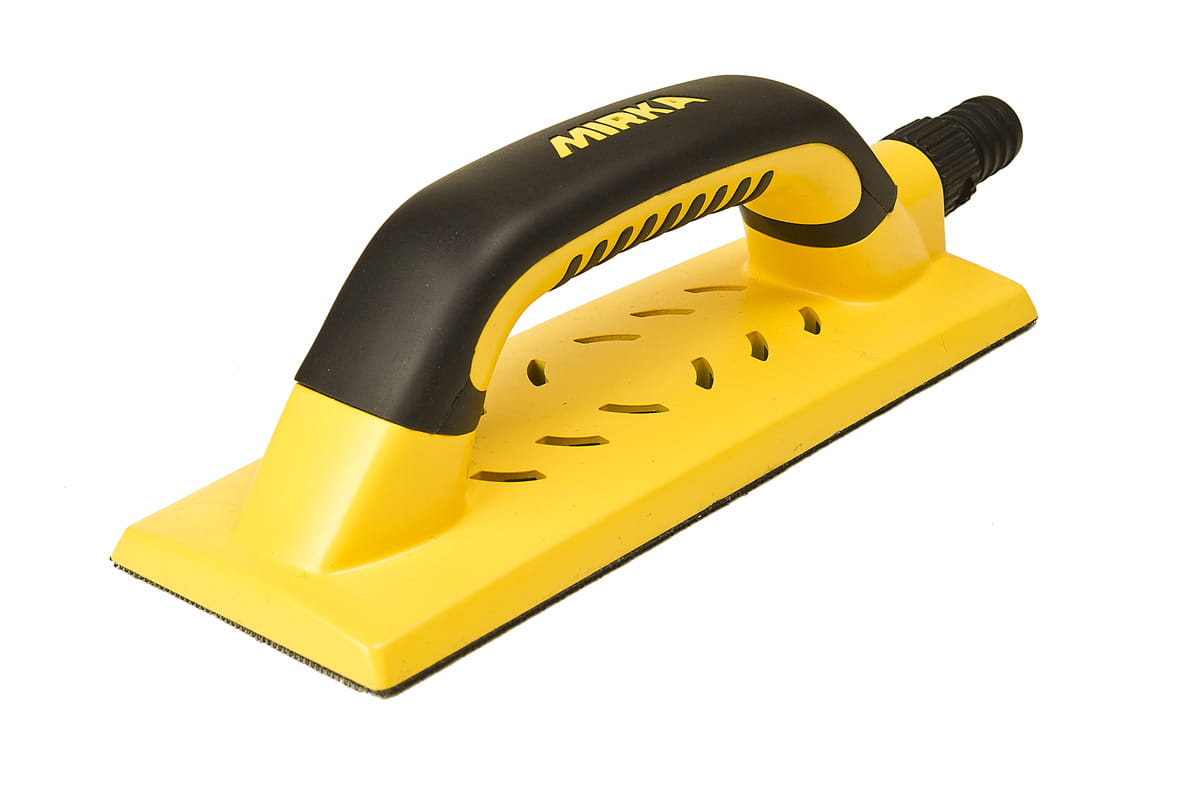
Flat surfaces, curves, profiles and hard-to-reach areas require different tool shapes. Discs, belts, rolls and sheets differ not only in format, but also in backing, abrasive grain and attachment. Choose a machine with a suitable working motion and a contact surface appropriate to the component. A hand sanding block complements machine sanding wherever contours or small areas require particular control.
First establish the scratch pattern required for the next operation. Heavy material removal, intermediate sanding and preparation for polishing have different objectives. Match the grit sequence to the initial condition and the coating or abrasive manufacturer's instructions. Check the surface between stages so that deeper scratches do not become apparent only after painting or polishing.
Effective dust collection begins at the contact surface: the abrasive, backing pad and interface pad must keep the airflow path clear. This also requires suitable hoses, sealed connections and an extraction unit appropriate to the dust generated. Follow your workplace risk assessment and the manufacturer's approvals; even a well-matched extraction system does not automatically replace other protective measures.
After sanding, matched polishing compounds, pads and cleaning cloths can help achieve the desired finish. Kits make it easier to assemble a workstation when their contents suit the equipment already available. Robotics components offer a separate approach for recurring processing tasks: the tool, control system and integration are planned around the specific component, rather than the designation of the sanding head alone.
Product areas for sanding, polishing, dust extraction and accessories in the manufacturer's portfolio.
Learn moreFurther guidance in the shop to help you distinguish between types of abrasive.
Learn moreStart with the material, its initial condition and the target surface finish. These determine the abrasive, tool shape and process sequence. Then check machine connections, dust extraction and existing accessories together.
No. A filler repair area has different requirements from intermediate paint sanding or preparation for high-gloss polishing. The specific coating build-up and its processing instructions are decisive.
No. Sanding is used, among other things, for material removal and controlled surface preparation. Polishing is a finishing operation matched to that process. The steps required depend on the type of defect and the desired result.
Tell us about the material, the machines you already have and the surface finish you want to achieve. This helps narrow down the choice of sanding products.
Enquire nowPlease feel free to contact us by phone or email and we will advise you quickly, competently and without obligation.
+49 7546 3520019
Mon-Fri, 9:00 a.m. - 4:00 p.m