Setting up Graco President 4-Ball (17E223) Correctly – Flow, Pressure & Maintenance in Practice
When a circulation pump runs too "hard," it causes unnecessary wear, air bubbles, or uneven flow. If it runs too "soft," it lacks stability and throughput. In this guide, you will receive practical guidelines and a clear process – so that your President 4-Ball primes quickly, runs stably, and lasts longer.
What is the 17E223?
The Graco President 4-Ball is a pneumatic piston pump designed for high throughput at lower cycle rates – ideal for circulation/supply, even with high-viscosity materials. The 17E223 is the 2:1 ratio version with a 1000 cc lower, open wet cup, and NPT connections.

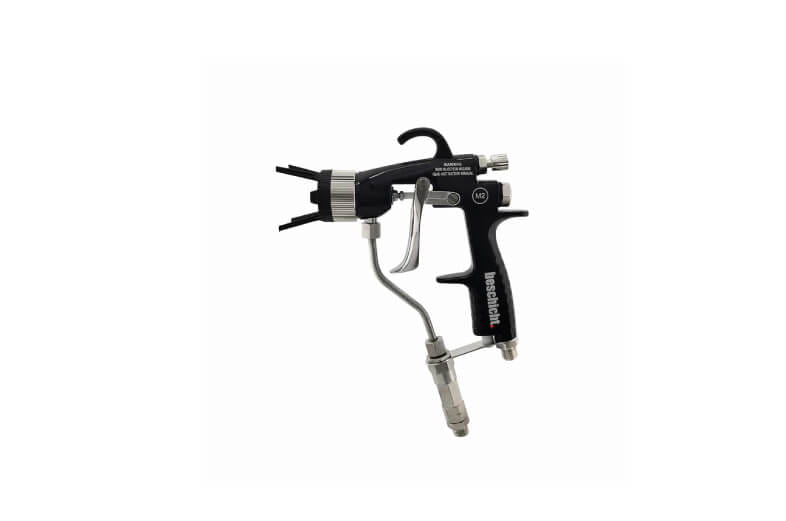
Note: Product image is for orientation purposes.
Product Overview: Variants & Applications (Quick Comparison)
| Model | Ratio | Lower | Material / Style | Connection | Max. Working Pressure | Typical Use |
|---|---|---|---|---|---|---|
| 17E223 | 2:1 | 1000 cc | Stainless Steel / Open (Wet Cup) | NPT | 460 psi (32 bar) | Circulation, high flow, robust supply |
| 17E222 | 2:1 | 1000 cc | Stainless Steel / Sealed | Tri-Clamp | 460 psi (32 bar) | Process/plant environment where sealed + clamp is desired |
| 17E224 | 2:1 | 1000 cc | CS / Open | NPT | 460 psi (32 bar) | When Carbon Steel material is sufficient (check cost/benefit) |
| 17E226 | 3:1 | 750 cc | Stainless Steel / Open | NPT | 460 psi (32 bar) | More pressure reserve through 3:1 ratio |
Tip: Don't choose "maximum," choose "suitable." A lower cycle rate for the same throughput often means: less pulsation, less wear, and longer service life.
CTA: Suitable President Pump directly in the Shop
Would you like to order or configure the appropriate version (e.g., Tri-Clamp / sealed lower) directly? Use the button – or inquire with us if you would like to check connection/material compatibility in advance.
View Suitable President Pump NowRecommended Basic Settings (Guidelines Derived from Documentation)
The following values are starting guidelines. They depend on material viscosity, hose lengths, filters, and valves. Important: Do not exceed the maximum permissible pressures.
- Air Pressure as a Starting Point: Start with a low supply pressure in the range of the references used in the performance charts (e.g., 2.8 bar / 4.9 bar) and increase only as far as necessary for the system to pump stably.
- Upper Limit Air Inlet Pressure: 2:1 models are specified up to 12 bar (180 psi).
- Cycle Rate / Continuous Operation: For the 17E223, a max. continuous double stroke rate of 12 cpm is specified. If more throughput is needed: first check bottlenecks (filters/lines/valves), then adjust air pressure moderately.
- Flow Orientation: For 2:1 / 1000 cc, up to 14.1 gpm (53.5 L/min) is mentioned as the max value – but stable, low-pulsation operation is the practical goal.
- Temperature Limit: The maximum fluid temperature is specified as 66 °C (observe system components).
Pro Workflow: Commissioning in 6 Steps
- System Depressurized & Safe: Relieve pressure before working on valves/filters/connections (otherwise pressure remains in the system).
- Prepare Wet Cup/TSL (for Wet Cup version): Fill the wet cup with TSL (may not be required for sealed versions).
- Regulator at "0" & Check Valves: Close the air regulator, keep the bleed/master air valve closed initially, open drain valves first, then close them again for pump start.
- Connect Lines & Check for Leaks: Air line to master air valve, material inlet from tank, material outlet to system – all fittings tight.
- Prime Slowly: Open master air, slowly turn up the air regulator until the pump starts. Then let it run at a low speed until air is completely out.
- Stabilize & Stop Correctly: After priming, bring the system to working condition. When shutting down: relieve pressure and stop the pump at the bottom of the stroke so that no material dries.
Troubleshooting (4 Typical Cases + Quick Measures)
- Check air supply: shut-off valves open, lines/filters clear.
- Check material supply: tank not empty, inlet not "sucking air."
- Check material line/filter/fittings for blockage and clean.
- Check ball check valves: worn or hanging open.
- Check packings and replace if necessary (refer to lower-specific manual).
- Check air supply/shut-off/regulator (most common cause).
- Check ball checks for correct assembly.
- If air motor is damaged: refer to air motor manual.
- Do not let the tank run empty (excessive cycle rate can cause damage).
- Check ball checks / packings.
- If material dries on the piston rod: disassemble, clean – stop at bottom of stroke in the future.
Maintenance (5 Points for Service Life)
- Flushing: Before color changes, before material dries, at the end of the day, before storage, and before repairs – and flush with the lowest possible pressure.
- Compatible Flushing Medium: Flushing fluid must match the material and wetted parts.
- Air Filter: Drain condensate and clean filter if necessary.
- Tank Management: Do not let the mix tank run empty, otherwise the pump runs too fast and can be seriously damaged.
- TSL/Wet Cup: Check condition/level regularly (at least weekly) and change the medium periodically.
FAQ (Practical)
Conclusion
The Graco President 4-Ball 17E223 shows its strength when you operate it smoothly, primed cleanly, and without unnecessary cycle rates. With the guidelines, the 6-step workflow, and a consistent flushing/maintenance plan, you avoid typical failures – and achieve permanently stable throughput from your system.