
Setting up the Graco Dura-Flo NXT 2-Ball Piston Pump Correctly – for Constant Flow & Less Downtime
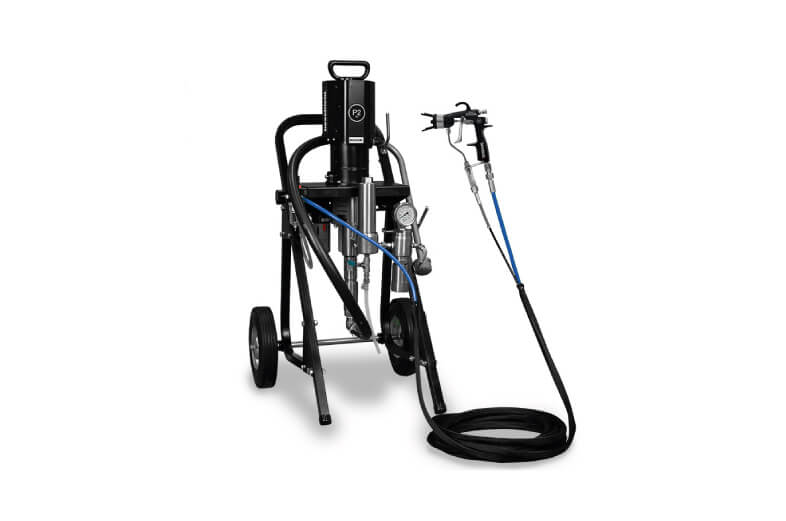
A 2-ball piston pump is truly effective when it pumps evenly in everyday use, is easy to adjust, and doesn't immediately "act up" during pressure fluctuations. In this practical guide, you will get a clear workflow, reference values (for orientation), and typical error patterns – so that your Graco Dura-Flo NXT 2-Ball runs reproducibly.
.jpg?ts=1772210351)
What this is about
Practical setup, reference values, workflow, troubleshooting, and maintenance – specifically for the Dura-Flo NXT 2-Ball Piston Pump. Goal: stable material supply with less downtime.
Product Overview: Variants, Uses, Advantages
| Variant | Typical Applications | Practical Benefit |
|---|---|---|
| 6:1 (e.g., low-noise exhaust motor) | Stable delivery at moderate pressures | Quiet operation, good for longer run times |
| 23:1 (optional with DataTrak) | Higher pressure requirements / thicker material | More pressure reserve, process data/monitoring possible |
| De-icing exhaust motor | Cold environments / high cycling rates | Helps against icing, more stable operational readiness |
Note: Variants/features are based on available product information. Specific limits vary per version.
Order Matching Dura-Flo NXT Directly
Do you want the variant with a low-noise exhaust motor and stainless steel/PTFE design? Click here to go directly to the product.
Recommended Basic Settings (Reference Values)
Without your specific material data/system, no fixed values can be seriously promised. Use the following points as guidelines and approach them in small steps.
- Air Supply: Clean, dry compressed air; check filters/water separators regularly.
- Pressure Buildup: Increase slowly until delivery is stable (do not start "at full throttle").
- Material Feed: Suction side free of air, short paths, no unnecessary cross-section restrictions.
- Temperature/Viscosity: Keep material within the recommended processing window; condition thick material if necessary.
- Monitoring: With DataTrak/monitoring: Do not ignore alarms – they are often early indicators.
Pro Workflow: 6 Steps to Stable Delivery
- Visual Check: Hoses, connections, material containers, filters – everything tight, clean, correctly mounted.
- Prepare Air: Prepare compressed air (filter/regulator), then slowly apply air.
- Prime Material: Suction/prime air-free until delivery is bubble-free.
- Ramp Up Gently: Increase pressure/stroking step by step until the application runs stably.
- Stabilize Process: Adjust material temperature, feed, and return (if applicable) to minimize pressure fluctuations.
- Document: Note your working settings (material, temp, pressure, nozzle/setup) – saves time on the next job.
Troubleshooting: 4 Typical Problems & Quick Actions
- Check the suction side for air intake/leaks (clamps, seals, couplings).
- Check and clean material filter/screen (clogging creates pressure fluctuations).
- Check material condition (viscosity/temperature) and condition if necessary.
- Check suction pipe/hose for kinks/blockages; do not unnecessarily reduce cross-sections.
- Check valve seats/balls for contamination/wear (tight seal).
- Check compressed air supply (regulator/line) for sufficient throughput.
- Ensure dry air (maintain water separator/filter).
- In cold environments: Choose a de-icing exhaust motor or appropriate version.
- Keep material tempered so the pump doesn't have to work against "too thick" material.
- Reduce air pressure and ramp up gradually – avoid aggressive starting.
- Check mechanical points (fastenings, air motor accessories, loose parts).
- Check maintenance status: seals/packings/lubrication according to schedule.
Maintenance: 5 Points Proven in Practice
- Maintain compressed air preparation regularly (filter elements, water separators).
- Clean or change material filters/screens according to the process plan.
- Check seals/packings for leakage and replace if necessary.
- Check valves/balls for wear, particles, and clean seating.
- Document settings/process data (material, temperature, pressure, running behavior).
FAQ
1) Which ratio fits – 6:1 or 23:1?
6:1 is often the smooth choice for moderate pressures and long run times. 23:1 offers more pressure reserve if the material/process requires higher pressures.
2) How do I recognize air in the material?
Typical symptoms are pulsation, "spitting," or an unstable spray pattern. First check the suction side, tightness, and material level.
3) Do I have to work with DataTrak?
Not necessarily – but monitoring/alarms can help detect deviations early and reduce downtime.
4) What is the most common reason for poor delivery?
In practice: Air on the suction side, clogged filters, or worn valve components. Always start diagnosis there.
5) How often should I perform service?
Depends on the material, run time, and environment. Follow a fixed plan (filters/seals/valves) and document any abnormalities.
Conclusion
With a clean setup (air-free suction side, good air preparation, slow ramp-up) and a simple diagnosis scheme, you can get the Dura-Flo NXT 2-Ball Piston Pump stable in your process. If you are looking for a suitable version, use the red CTAs – and secure a setup that runs reliably in everyday use.