
✔ Manufacturer-neutral advice ✔ Technical consulting ✔ Spare parts & service available ✔ Experience from industry & trades
Solvent distillation: Why a distillation unit pays off in daily operations
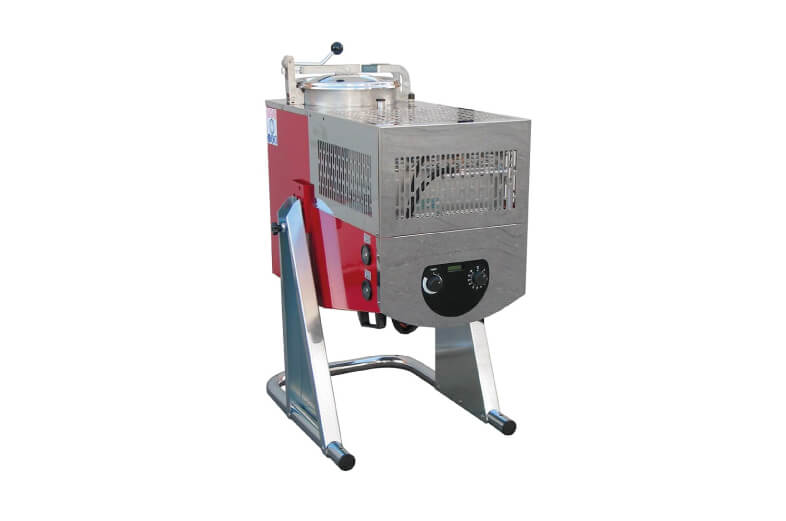
A distillation unit enables the recovery of used solvents from cleaning, degreasing and coating processes. Typical contaminants such as resins, paints, pigments, oils or greases are reliably separated from the solvent – the purified distillate can then be reused in the process. This lowers material costs and significantly reduces disposal effort.
The contaminated solvent is heated in the boiler/kettle (electric heating element, indirectly via heat transfer oil). The resulting vapors are routed into an air- or water-cooled condenser where they are liquefied again. The result: consistent solvent quality with clean separation of residues.
Modern systems work with microprocessor control, allowing multiple distillation phases to be set. This not only improves cleaning, but also enables better separation of low- and high-boiling solvent fractions – especially helpful for demanding mixtures and changing contamination.
- Reduce costs: less purchasing, less disposal, higher profitability
- Stabilize processes: consistent cleaning results through reproducible distillate
- Handle residues safely: depending on contamination, as liquid residue or solid fractions
Depending on the application, useful options are available – e.g. automatic filling, automatic residue discharge or returning the distillate to storage tanks. For solid residues (e.g. paints, resins or polymer fractions), systems such as the RecBag offer a particularly practical solution: residues are collected in a bag and can be removed cleanly, without time-consuming cleaning of the boiler.
Vacuum reduces the ambient pressure inside the unit and thus lowers the solvent’s boiling temperature. This enables distillation at significantly lower temperatures: it protects temperature-sensitive solvents, reduces odor and emissions, and lowers energy consumption.
Tip: For high-boiling or flammable solvents, a vacuum unit can be useful. This allows processes to be designed more safely and efficiently – we’re happy to support you with selection, accessories and integration.
Typical applications
Paint shops, workshop/industrial cleaning, degreasing, maintenance, contract coating.
Key criteria
Capacity, solvent type, residue, safety/ex protection, automation, accessories.
Expert advice
We help with selection and sizing – tailored to material, process and quality target.
Distillation units – models in our range
The designation D 12 / D 25 / D 60 / D 120 stands for the size class – and is based on the fill volume. This helps you quickly find the right unit for your solvent requirements. The tiles show the most important key data at a glance.

D 12
Compact unit for small batches and regular cleaning tasks.
- Fill volume: 12 L
- Recommended for: small quantities / workshop
- Distillation time: 4 to 5 hours

D 25
A proven size for operations – a good balance of capacity and handling.
- Fill volume: 25 - 30 L
- Recommended for: regular use / operations
- Distillation time: 4 to 5 hours

D 60
For higher throughput – ideal when solvent volumes are larger.
- Fill volume: 60 L
- Recommended for: high demand / frequent batches
- Distillation time: 4 to 5 hours

D 120
Large unit for serial operation and regular recovery of large volumes.
- Fill volume: 120 L
- Recommended for: industry / serial operation
- Distillation time: 4 to 5 hours

Accessories
Suitable options and consumables – matched to your unit size.
- Compatible with: D 12 / D 25 / D 60 / D 120
- Typical: liner bags, collection containers, spare parts
Vacuum distillation units (DV) – recover solvents efficiently
Operating under vacuum reduces the system pressure – and therefore lowers the boiling temperature. This allows solvents to be distilled gently at lower temperatures, saving energy and preserving product quality.

DV 25 Ax – LCD
Vacuum distillation for gentle solvent recovery – ideal for regular use.
- Fill volume: 25 L
- Recommended for: workshop & operations (regular demand)
- Vacuum benefit: lower temperature → gentler on materials
- Distillation time: approx. 4–5 hours (depending on medium)

DV 12 Ax – LCD
Compact vacuum distillation for small batches – gentle and efficient for everyday use.
- Fill volume: 12 L
- Recommended for: small quantities / workshop
- Vacuum benefit: lower temperature → gentler on materials
- Distillation time: approx. 4–5 hours (depending on medium)
Free distillation test – confidence before choosing a unit
Have your contaminated solvent tested with no obligation. We assess recoverability, document the results and derive a well-founded recommendation for the right distillation unit.

Profitability calculator – calculate your savings potential
How quickly does a distillation unit pay for itself in your operation? Based on your consumption data, we determine the concrete savings potential and show when the investment becomes economically worthwhile.

Every application is different. That’s why we calculate profitability individually based on your real consumption data. You send us the key figures – we do the calculation and present the results clearly for you.
What information we need
- Solvent type: e.g. acetone, thinner, cleaning medium
- Monthly consumption: quantity in liters
- Disposal costs: €/liter or €/batch (if known)
- Purchase price: €/liter of fresh solvent
- Operating days: per week / month
Using this data, we calculate for you:
- Savings potential per month and per year
- Payback period of the distillation unit
- Suitable unit size (e.g. D 25, D 60, vacuum version)
Go to contact form
Frequently asked questions about distillation units
Short answers on function, selection and use – for confident decisions in everyday professional work.
How does a solvent distillation unit work?
The used solvent is heated, evaporates and is then liquefied again in the condenser. Contaminants remain as residue – depending on the application, the reprocessed solvent can be reused.
Which unit fits my needs?
Key factors are solvent type, contamination, batch size and desired throughput. If you tell us these points, we’ll recommend the right unit size.
Which solvents are generally suitable?
Many cleaning and degreasing solvents can generally be reprocessed. Whether it fits in detail depends on composition (e.g. mixtures), boiling point and impurities – we’ll be happy to clarify this with you.
What happens to the residue?
Paints, resins, pigments or oils remain as a concentrated residue. Depending on the process, it is discharged at sensible intervals and disposed of properly.
How long does a distillation cycle take?
This depends on fill volume, solvent, contamination and cooling. For a quick estimate, the solvent type and the quantity per week/day are sufficient.
Where can I find the available models?
You can find all distillation units in our range in the category: Distillation units.
I’m unsure – how can I quickly get a recommendation?
The quickest way is with 4 details: solvent type, contamination (what’s in it?), quantity/batch and your goal (e.g. cut costs, consistent cleaning). Use our contact form.
Customer reviews
Experiences from industry & workshops – real feedback on consulting, delivery times and product quality.
Need help selecting or sizing a unit?
We advise you personally – tailored to solvent type, contamination, batch size and process. This way you’ll quickly find the right distillation unit from our range.