
DeVilbiss FLG5 Spray Gun: Your Guide to Efficient and Precise Coating
The DeVilbiss FLG5 spray gun series combines performance and cost-efficiency for demanding coating applications. Whether in general industry, craftsmanship, or furniture manufacturing – this spray gun is the ideal tool for a wide range of materials. Our guide shows you how to get the maximum performance out of your FLG5.

FLG5 Overview: Variants and Their Strengths
The FLG5 series offers the right solution for every requirement. The choice between suction feed, gravity feed, and pressure feed determines your workflow.
| Variant | Label | Ideal for | Advantage |
|---|---|---|---|
| Gravity feed | G | Standard applications, medium material volumes | Good control, economical set |
| Suction feed | S | Smaller projects, frequent color changes | Easy cleaning, flexible |
| Pressure feed | P | Large surfaces, high throughput | No interruptions for refilling, faster workflow |
Note: The order designation consists of type (FLG5), air cap (e.g., G5), and nozzle size (e.g., 14 for 1.4 mm).
Robust & Lightweight
Aluminum cast gun body ensures durability with minimal weight. Ergonomic grip for fatigue-free working.
Trans-Tech® Technology
Provides excellent surface quality and material savings. Supports compliance with VOC regulations.
Precision Components
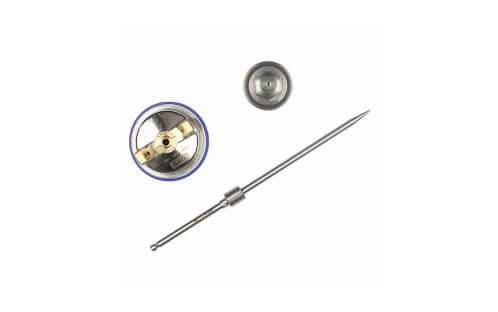
Brass tip plus stainless-steel nozzle and needle ensure consistent performance and long service life.
Ready for Perfect Results?
Discover the DeVilbiss FLG5 gravity feed spray gun with Trans-Tech technology and 600 ml cup in our shop – your partner for professional coating.
To the FLG5 Gravity Feed GunRecommended Basic Settings (Reference Values)
For an optimal spray pattern, pressure and material settings are crucial. These values serve as a baseline and must be adjusted depending on material viscosity.
| Gun Type | Air Cap | Inlet Pressure | Air Consumption (approx.) |
|---|---|---|---|
| Cup gun (suction/gravity) | No. 5 | 2.0 bar | 280 l/min |
| Pressure feed gun | No. 622 | 2.3 bar | 310 l/min |
Typical flow rate: 200–280 ml/min. Typical spray pattern size: approx. 200 mm. Material inlet and air inlet have 1/4" universal threads.
Professional Workflow in 6 Steps
- Preparation: Bring material to processing viscosity (according to manufacturer). Clean workpiece and prime if necessary.
- Configure the gun: Select the right nozzle/needle combination (e.g., 1.4 mm) and air cap (No. 5 or 622) and install them.
- Set pressure: Adjust compressor and regulator to the recommended inlet pressure (2.0 or 2.3 bar).
- Test spray: Spray on test surface (cardboard). Evaluate spray pattern (shape, wetness) and material flow. Adjust settings.
- Coating: Hold gun at correct distance (approx. 15–20 cm) parallel to the surface with even speed and overlap (approx. 50%).
- Cleaning: Flush the gun immediately after use with suitable cleaner to avoid residue in the nozzle and channels.
Common Problems & Solutions
1. Orange Peel / Poor Flow
- Material too thick? – Thin with appropriate reducer.
- Air pressure too low or gun distance too large? – Increase pressure or reduce distance.
- Environment too cold? – Warm material and workpiece.
2. Drips from Nozzle
- Needle tip or nozzle seat worn/dirty? – Clean or replace components.
- Material pressure (pressure feed) too high? – Reduce pressure.
3. Irregular Spray Pattern
- Air cap or nozzle clogged? – Clean thoroughly.
- Damaged air cap holes? – Replace air cap.
4. Low Material Flow
- Nozzle clogged? – Clean.
- Material filter (cup/pressure pot) blocked? – Clean or replace.
- Material too cold/viscous? – Increase temperature or thin.
Quick Maintenance Checklist
- Daily/After each use: Flush gun immediately with suitable solvent.
- Weekly/When performance drops: Remove air cap, nozzle, and needle and soak in cleaning solution. Check nozzle seat and needle tip for wear.
- Regularly: Check all seals (O-rings) for cracks or brittleness and replace if needed.
- Air system: Drain water separator and compressor filters regularly.
- Storage: Store the gun fully cleaned and depressurized. Ideally hung to protect seals.
FAQ – Frequently Asked Questions
Which materials is the FLG5 suitable for?
According to the manufacturer, it is suitable for paints, primers, fillers, oils, adhesives and many other solvent-based materials.
What does “Trans-Tech®” mean?
This is DeVilbiss’ patented atomization technology. It enables fine, uniform atomization, resulting in excellent surface quality and reduced material consumption.
Can I change the nozzle myself?
Yes, the fluid nozzle, needle, and air cap are consumables and can be replaced by the user. Make sure to use matching sets (nozzle + needle).
What compressor is required?
A compressor with a delivery rate of at least 300–350 l/min (approx. 5–6 l/s) and a regulator is recommended to keep the required air pressure (2.0–2.3 bar) stable.
What is the difference between air cap No. 5 and No. 622?
Air cap No. 5 is designed for cup guns (gravity/suction). Air cap No. 622 is for pressure feed guns and optimized for higher material throughput.
Conclusion
The DeVilbiss FLG5 spray gun is a versatile and reliable choice for professional users. Its robust construction, efficient Trans-Tech atomization, and flexibility through various cup configurations make it the ideal tool for nearly all coating tasks. With correct settings, a clean workflow, and regular maintenance, you will consistently achieve first-class results and significantly extend the lifespan of your equipment.