
Practical Guide

SATAjet X 5500 PHASER: HVLP vs. RP – how professionals choose correctly
This guide helps you select the right PHASER variant for basecoat and clearcoat. With compact reference values, a reliable workflow, and quick troubleshooting, you can increase quality and efficiency – reproducible in daily operation.
Product Overview
The SATAjet X 5500 PHASER is the design edition of the X-series with X-nozzle technology. It is available as HVLP and RP – both deliver a smooth, homogeneous spray pattern. Choose the variant according to material, surface size, and speed.
| Variant | Typical Applications | Key Benefits |
|---|---|---|
| HVLP | Efficient basecoats, spot to full panels, fine edges | Very high transfer rate, reduced overspray, material saving |
| RP | Clearcoats and large surfaces at high speed | Fast application, smooth finish, universally applicable |
Comparison: HVLP vs. RP (Reference Values)
| Criterion | HVLP | RP |
|---|---|---|
| Working pressure at the gun | approx. 2.0 bar | approx. 2.2–2.5 bar |
| Spray distance | 15–20 cm | 17–22 cm |
| Recommended nozzle sizes | 1.2–1.4 | 1.2–1.3 |
| Strengths | High efficiency, fine edges | Very smooth finish, speed |
Note: Values are reference values and depend on paint system, temperature, and viscosity.
X-Nozzle Technology
Homogeneous spray pattern, smooth operation, reproducible quality.
Nozzle sets
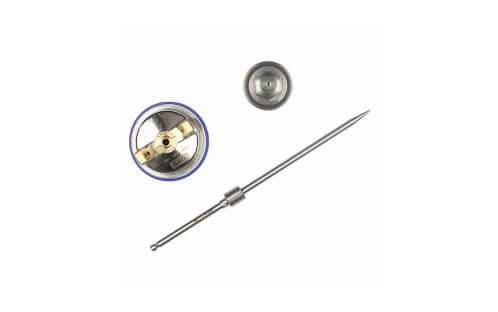
Proven: Basecoat 1.2–1.3; Clearcoat often 1.3 (RP) or 1.4 (HVLP).
Max. inlet pressure
Typically 10 bar (device), operate within recommended working range.
Tip: First set air and material flow regulators moderately (e.g. 3/4 open, material 1.5–2 turns) and calibrate pressure/viscosity on a test panel before painting the part.
Recommended Basic Settings (Reference Values)
- HVLP: approx. 2.0 bar at the gun; 15–20 cm distance; fan fully open; material 1.5–2 turns.
- RP: approx. 2.2–2.5 bar; 17–22 cm distance; fan fully open; material 1.25–1.75 turns.
- Nozzle: Basecoat 1.2–1.3; Clearcoat 1.3 (RP) or 1.4 (HVLP) – depending on system.
- Overlap: 70–75% for even layer formation without dry edges.
Always follow the paint manufacturer’s instructions; ambient conditions may require adjustments.
Professional Workflow (6 Steps)
- Prepare substrate: clean, degrease, blow dust-free; check masking.
- Select variant and nozzle (HVLP for efficiency/fineness, RP for speed/flow); adjust pressure.
- Spray test panel: fine-tune fan/material/pressure; adjust viscosity if needed.
- Apply basecoat in even passes with 70–75% overlap.
- Flash-off according to system specifications; apply clearcoat with constant distance and speed.
- Final inspection, touch-ups; briefly flush gun, avoid buildup on nozzle/air cap.
Troubleshooting
Runs
- Reduce material flow, slightly increase gun speed.
- Increase viscosity or try one nozzle size smaller.
- Slightly increase distance, observe flash-off time.
Orange Peel
- Moderately increase pressure, properly center the fan.
- Reduce viscosity; check ambient temperature/flow.
- Use more consistent gun speed, slightly increase overlap.
Dry Edges
- Lower pressure slightly, reduce distance.
- Increase pass overlap to 70–75%.
- First “wet” the edge zones, then close the surface.
Unstable Spray Fan
- Clean and properly align air cap/nozzle.
- Check strainer/cup, open air flow regulator.
- Fine-tune pressure, slightly reduce material.
Maintenance (Compact)
- After each use, clean nozzle, needle, air cap, and channels.
- Regularly check seals and needle guide, replace when worn.
- Use only compatible cleaners; avoid hard wires/brushes.
- Lightly grease threads; protect O-rings from swelling.
- Store dry/dust-protected; keep cup clean separately.