Setting up the P2 E17 Airless Sprayer correctly – for a clean spray pattern & fast cleaning
When an Airless "spits," leaves streaks, or the nozzle constantly clogs, it's almost always due to three things: material flow (suction/priming), pressure buildup (starting cleanly from the minimum), and the cleaning routine. This guide shows you a field-tested process – including guide values, professional workflow, troubleshooting, and maintenance.

Product Overview: Applications, Scope of Delivery, Advantages
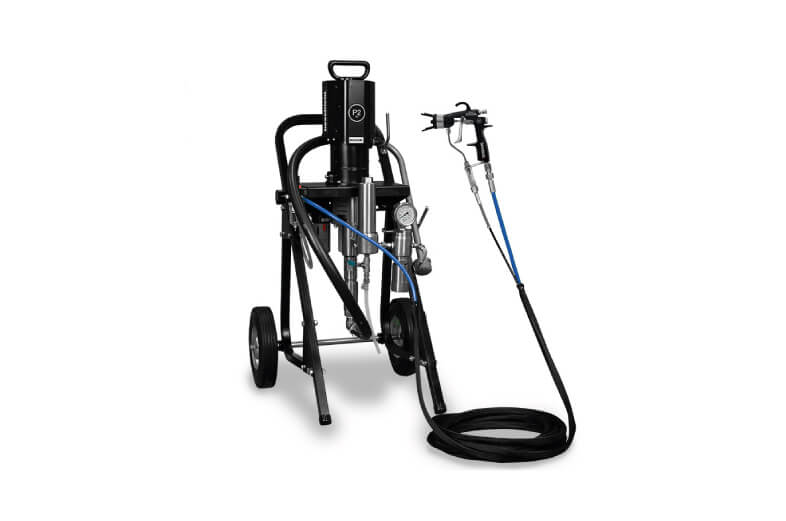
The P2 E17 is a compact, mobile Airless system for lacquers, glazes, and interior emulsion paints – including a gun, pressure gauge, 7.5 m high-pressure hose, and a standard 517 nozzle. Ideal if you want to get started quickly and value a reproducible spray pattern.
| Topic | Practical Classification |
|---|---|
| Areas of Application | Water- & solvent-based paints/glazes, interior latex/emulsion |
| Not Suitable For | Fillers/putty, facade paints, lye, highly flammable materials |
| Performance (Guide Value) | Up to approx. 1.44 l/min flow rate, up to approx. 207 bar maximum pressure |
| Standard Setup | 517 nozzle (0.017"), hose up to 7.5 m, 1/4" NPS connection |
| Operating Environment | Temperature range approx. 5–40 °C |
Recommended Basic Settings (as Guide Values)
The following settings are deliberately formulated as guide values – fine-tuning may be necessary depending on the material, temperature, and surface. The sequence is important: first prime/bleed correctly, then stabilize the pressure.
- Set up the pump horizontally and check all connections firmly (hose/gauge/output components must be pressure-resistant).
- Set relief/prime valve to "Prime" for filling/bleeding; later to "Spray" for spraying.
- Start pressure regulator at minimum and increase slowly until the spray pattern becomes clean.
- Use the 180° reversing nozzle function: Turn briefly to the cleaning position for filling/rinsing and for quick unclogging.
- Spraying Technique: Guide passes with approx. 30% overlap for uniform coverage.
Pro Workflow: 6 Steps from Bucket to Surface
- Setup & Safety: Place the device horizontally, engage the gun safety (trigger lock), and check all connections. Use personal protective equipment.
- Prepare Suction: Submerge the suction and return hoses into the material container. Set the relief valve to Prime, and the pressure regulator to Prime/Clean or a low setting.
- Prime Material/Bleed Air: Turn on the device. You should see air bubbles until the system is filled. If not: operate the inlet valve pusher at the bottom of the pump.
- Fill the Hose: Set the relief valve to Spray, point the gun into the bucket (nozzle 180° in cleaning position), and trigger briefly until material exits cleanly. Secure the gun again.
- Adjust Spray Pattern: Set nozzle to spray direction, ramp up pressure slowly from minimum, and spray a test area. Goal: a uniform fan without "tails" or streaks.
- Spray Cleanly: Work in passes with approx. 30% overlap, keeping the gun in motion. If clogged: secure gun, turn nozzle 180°, spray briefly to clear, then turn back.
Troubleshooting: 4 Typical Problems – Solved Quickly
1) Motor does not run
- Check power supply and ensure the device is correctly plugged in.
- Do not leave the pressure regulator at minimum: increase pressure slowly until the control system starts cleanly.
2) Pump does not suck material
- Material viscosity too high: Dilute material appropriately (refer to manufacturer data).
- Check suction system/connections for air leaks (leak = drawing air).
- Inlet valve is stuck: Press the inlet valve pusher on the underside of the pump several times.
3) Material does not come out of the gun despite pressure
- Nozzle clogged: Turn nozzle 180°, spray briefly to clear, then turn 180° back and continue working.
- Gun filter clogged: Remove and clean or replace the filter.
4) Unstable spray pattern / fast wear
- Do not let the pump run dry: only for very brief moments – otherwise, premature wear/damage may occur.
- Consistent cleaning routine: Regularly remove and rinse the nozzle, holder, and filters.
Maintenance & Cleaning (5 Points to Save Time)
- Always depressurize before cleaning: Release system pressure via the relief valve (Prime position).
- Use appropriate cleaning medium: Warm water for water-based materials; suitable solvents only according to manufacturer specifications.
- Remove nozzle/holder/filter: Remove parts and clean them thoroughly separately – do not spray cleaning agent "through the nozzle."
- Return line to waste container: When rinsing, lead the return hose into a suitable waste bucket.
- Storage: For longer downtime, add a few drops of machine oil into the designated openings and run briefly (very briefly).

FAQ: Common Practical Questions about the P2 E17
Conclusion
With the P2 E17, you get a compact Ready-to-Spray Airless setup that shines especially when you bleed air correctly, build up pressure controlled from the minimum, and consistently use the reversing nozzle plus the Prime/Clean routine. Following the workflow above significantly reduces downtime (nozzle/filter/suction) – and leads to uniform surfaces faster.