
The Ultimate Guide: Which Abrasive for Which Application?
Abrasives are an essential part of many craft and industrial processes. Choosing the right abrasive can mean the difference between a smooth, professional finish and a less than satisfactory job. In this article, you will learn which abrasive is suitable for which application, what the differences are between the different types of abrasives, and how you can achieve the best result.

1. Abranet®abrasives
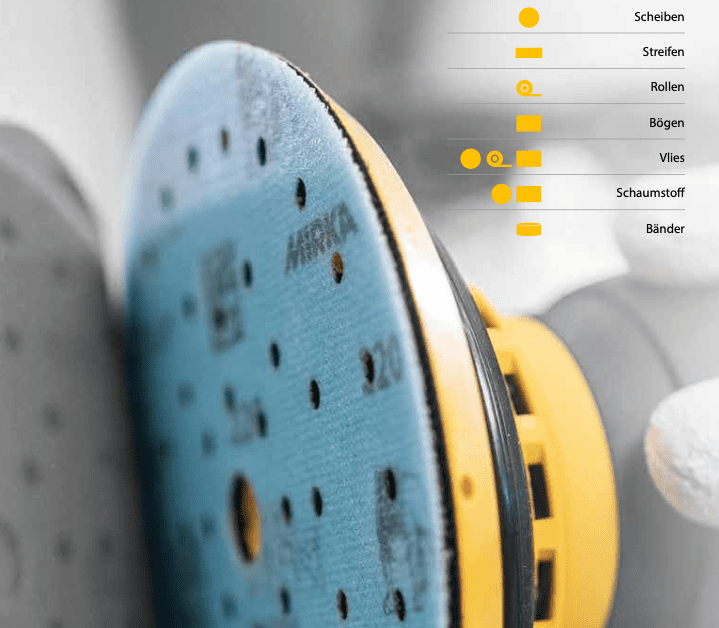
Abranet® abrasives are known for their mesh structure, which enables a dust-free sanding environment. These abrasives are particularly suitable for:
- • Paint: the net structure ensures that dust is effectively extracted and does not clog the surface.
- Wood: Thanks to the flexibility of the material, even uneven wooden surfaces can be sanded evenly.
- Metal: Abranet® abrasives are robust enough to work on metal surfaces without wearing out quickly.
2. Abralon® abrasives
Abralon® abrasives consist of an abrasive mesh on a foam backing, ideal for:
- Contour grinding: the flexible foam adapts perfectly to complex shapes and contours.
- Fine finishing: the wide range of grit sizes allows for very fine surface finishing.
3. Goldflex-Soft abrasives
Goldflex-Soft abrasives are equipped with a flexible finishing paper on foam, ideal for:
- Varnish and putty: the flexibility of the material makes it easy to sand curved and hard-to-reach areas.
- Wood: perfect for finishing wooden surfaces, to achieve a smooth and even surface.
4. Mirlon®and Mirlon Total®abrasives
These abrasives consist of a three-dimensional non-woven fabric that is particularly suitable for:
- Cleaning and finishing: ideal for cleaning surfaces and creating an even finish.
- Metal: well suited for working on metal surfaces, especially for preparation and cleaning prior to painting.
5. Basecut Abras ives
Basecut abrasives are characterised by a flexible latex paper and a high removal rate, making them particularly suitable for:
- Wood: Ideal for coarse and intermediate sanding of wooden surfaces.
- Varnish: Efficient for removing old layers of varnish and preparing for new coats of paint.
6. fibre abrasives
Fiber abrasives are made of vulcanised fibre and are particularly robust, ideal for:
- Metal: Excellent for aggressive sanding on metal surfaces.
- Weld seams: Perfect for working on and smoothing weld seams and other metal joints.
7. Iridium Abrasives
Iridium abrasives combine ceramic and aluminium oxide grains and are particularly suitable for:
- Wood and varnish: the durable grains and latex paper provide consistent sanding performance and a high-quality finish.
- Metal: The robust nature of these abrasives also makes them suitable for working on metal surfaces.
8. Caratflex abrasives
Caratflex abrasives are made of flexible paper impregnated with silicon carbide and are ideal for:
- • Paint: These abrasives are particularly suitable for the intermediate and final sanding ofpainted surfaces.
- Wood: Perfect for fine intermediate sanding on wooden surfaces.
9. Coarse Cut abrasives
Coarse Cut abrasives are made of specially reinforced F-paper with aluminium oxide and are ideal for:
- Coarse sanding: Ideal for quickly and effectively removing material.
- Metal: Ideal for grinding metals, especially when preparing for welding.
10. Gold Abrasives
Gold abrasives are made of flexible latex paper with aluminium oxide and are versatile for:
- Wood: Perfect for all sanding jobs on wooden surfaces, from coarse to fine sanding.
- Varnish and putty: Suitable for intermediate sanding of varnishes andputties.
11. Galaxy Abrasives
Galaxy abrasives combine ceramic and aluminium oxide grains and are ideal for:
- Dust-free sanding: the special coating prevents the abrasives from clogging and ensures a longer lifespan.
- Wood and varnish: well suited for working on wood and varnished surfaces, particularly where a high level of dust-free performance is required.
Differences between the abrasives
The various abrasives differ in terms of material, flexibility, abrasiveness and application specificity:
- Material: Abrasives can be made of aluminium oxide, silicon carbide, ceramic or a mixture of these. Each material has specific properties that make it more suitable for certain applications.
- Flexibility: Abrasives with a foam backing or a flexible backing are ideal for contoured or uneven surfaces, while more rigid abrasives are better suited for flat and hard surfaces.
- Abrasiveness: the grit size determines the abrasiveness of the material. Coarse grits (e.g. 40-60) are suitable for material removal and coarse sanding, while fine grits (e.g. 320-4000) are used for finishing and polishing.
- Specific applications: some abrasives have been specially developed for certain materials or surfaces, such as Abranet® for dust-free sanding or Mirlon® for cleaning and finishing.
Summary
Selecting the right abrasive depends on many factors, including the material being worked on, the desired surface and the specific requirements of your project. A comprehensive table listing the main applications for each abrasive can be found below. This table will help you choose the right abrasive for your needs.
By choosing the right abrasive, you can increase the efficiency of your work, improve the quality of the results and ultimately save time and costs. If you have any questions or require further information, please do not hesitate to contact us.