How to correctly adjust the PRONA RA-101 automatic spray gun
Anyone wanting to achieve a uniform spray pattern, reproducible material delivery, and stable operation in automated painting processes needs more than just the right nozzle. In this practical guide, we summarize the most important guidelines, workflows, and maintenance points for the PRONA RA-101 series in a compact and application-oriented way.
The focus is on the RA-101 series with pressure-fed material supply. All settings for pressure, viscosity, and spray distance are to be understood as guidelines and must be adapted to the material, system, and component geometry.

Product Overview: Variants, Applications, Advantages
| Area | Practical Benefit |
|---|---|
| Series | RA-101 and RA-200 as automatic spray guns for industrial or integrated coating processes. |
| Material Supply | Pressure-fed design for uniform material supply in system operation. |
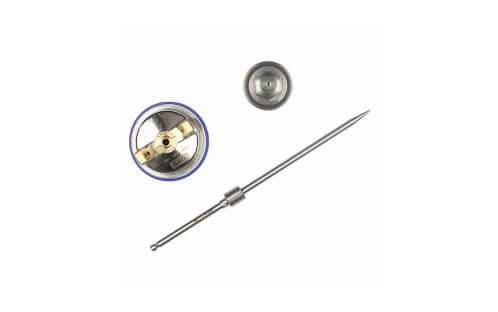
| Nozzle Sizes | Depending on the model, different nozzle and needle sets are available, typically from finer to larger cross-sections for various material quantities. |
| Material in Fluid Path | Fluid channel, needle, and nozzle are made of stainless steel according to the manufacturer, making them also suitable for water-based materials. |
| Pressure Range | The product page mentions an adjustable air pressure range of approximately 2.5 to 3.5 bar. During operation, the actual value should always be fine-tuned via the spray pattern. |
| Typical Application | Automated painting and coating processes requiring reproducible atomization, defined material delivery, and a compact gun design. |
View Matching PRONA RA-101 Directly
Are you looking for the right version for fine and reproducible coating processes? Then check out the product page featuring the 0.8 mm version.
View PRONA RA-101 NowRecommended Basic Settings for Startup
The following values are guidelines, derived from operating instructions and manufacturer specifications. Deviations are normal depending on the paint material, line cross-section, system pressure, air cap, and nozzle set.
| Parameter | Starting Value / Guideline | Note |
|---|---|---|
| Atomization Pressure | approx. 2.5 to 3.5 bar | Adjustable range according to product page; fine-tune via spray pattern and material delivery. |
| Viscosity | approx. 15 to 23 s Ford #4 | Listed in manual as recommended range. |
| Spray Distance | approx. 200 mm | Stated on product page for RA-101-RC; adapt in practice to component and fan width. |
| Material Filtration | approx. 60 to 90 mesh | Recommended in manual to reduce disruptions and nozzle problems. |
| Line Cross-section | Fluid min. 4 mm, Air line min. 6 mm ID | Guidelines from operating manual for sufficient supply. |
Nozzle Sizes and Performance Range at a Glance
In the operating overview, several nozzle sizes with different material flow rates and fan widths are listed for the RA-101 series. Values vary depending on the air cap set and version. In practice: smaller nozzle sizes work more gently and finely, larger nozzle sizes allow for higher discharge.
| Nozzle Size | Typical Use | Material Output Tendency | Spray Pattern Tendency |
|---|---|---|---|
| 0.8 mm | Finer coatings, lower material quantities, controlled application | low | compact to fine |
| 1.0 mm | Universal starting point for many standard materials | low to medium | uniform |
| 1.3 to 1.5 mm | Higher material flow with maintained controlled atomization | medium | wider fan pattern |
| 1.8 mm | Higher material quantities or more viscous media within allowed range | high | tends to be wider |
Professional Workflow in 6 Steps
- Prepare Material: Adjust paint or coating medium to the intended viscosity range and filter before filling.
- Check Connections: Connect air, material, and control air correctly. Ensure sufficiently dimensioned lines so that supply doesn't drop.
- Set Starting Pressure: Begin with moderate air pressure within the manufacturer's range and first establish a stable, reproducible spray pattern.
- Test Spray Pattern: Tune distance, material quantity, and fan pattern on a test panel or sample part. Do not start directly on the production component.
- Fine-Tune: If the center is too heavy, check material/viscosity first; for split patterns, reduce air or adjust material.
- Clean After Use: Clean air cap and fluid nozzle with suitable tools, flush material path, and check wear parts.
Troubleshooting: 4 Typical Problems and Solutions
| Problem | Probable Cause | Actions |
|---|---|---|
| Fluttering / unstable spraying | Insufficient material supply, wear or loose packing, loose or damaged fluid nozzle | Stabilize material supply, check or readjust packing, tighten or replace fluid nozzle |
| Crescent / one-sided spray pattern | Material buildup on the air cap or clogged air holes | Clean air cap, clean holes only with suitable soft tools |
| Split / drawn-apart spray | Material too thin or quantity too low, air pressure too high | Increase viscosity, check material quantity, reduce air pressure gradually |
| Heavy center / too much material in the middle | Material too thick or too much material, air pressure too low | Reduce viscosity, control material quantity, increase air pressure carefully |
Maintenance: 5 Points You Should Schedule
- Clean air cap and fluid nozzle after every use with a brush and suitable cleaning medium.
- Do not use hard metal tools for air holes to avoid damage.
- Flush material path clean after finishing work, especially with water-based materials.
- Regularly check nozzle, needle, and packing for wear, leakage, and free movement.
- Disconnect material and air supply safely before maintenance work.
FAQ for PRONA RA-101
Conclusion
The PRONA RA-101 is interesting for automated coating processes where a compact automatic spray gun with variable nozzle sets, clean atomization, and reproducible material delivery is required. Three points are particularly crucial for stable results: correctly filtered material, a sensible starting range for air pressure and viscosity, and consistent cleaning of the air cap and fluid nozzle. Those who master these basics significantly reduce typical spray pattern errors and gain more process reliability from the system.