Using the Binks AG-364 Correctly: Nozzle Selection, Pressure Settings, Troubleshooting, and Maintenance
The Binks AG-364 is designed for automatic airless coating processes on machines and fixed mounts. This practical guide shows you how to choose the right variant, work with sensible starting values, and resolve typical spray errors more quickly.
Why the AG-364 is ideal for automatic processes
The gun is designed for quick changes, fixed installation scenarios, and reproducible airless application. The stainless steel head is suitable for both water- and solvent-based applications, while the modular manifold concept simplifies disassembly for cleaning and service.
In practice, one point is particularly relevant: atomization and fan width in this system are not determined by additional atomizing air, but by fluid pressure and nozzle selection. This is exactly why nozzle size, fan length, and material viscosity are the central control levers.

Product Overview: Variants, Applications, Advantages
| Area | Details |
|---|---|
| Product Family | Binks AG364 Airless Automatic Manifold Gun |
| Variants | AG364-0000-S with non-circulating manifold and AG364-0000-T with circulating manifold |
| Typical Applications | General industrial coatings, fine surfaces, automatic machine and fixed-mount applications |
| Materials | Gun head and fluid paths made of stainless steel, housing made of anodized aluminum, needle/seat made of stainless steel and tungsten carbide, seals made of HDPE and FEPM |
| Machine Integration | Screw-on manifold with low profile height; gun can be removed for maintenance or cleaning while the manifold remains on the machine |
| Practical Advantages | Clean integration into automatic processes, flexible nozzle selection, indexable nozzle holder, well-suited for reproducible series coating |
View the matching AG-364 variant directly
Do you need the circulating version without a nozzle for your machine integration? Then use the product page as a starting point for selection and inquiries.
To the product pageRecommended Basic Settings for the Binks AG-364
The following values are intended as guidelines. The manual states technical limits and a typical starting sequence; the final process tuning depends on the material, viscosity, desired layer thickness, nozzle pattern, workpiece distance, and travel speed.
| Parameter | Practical Guideline / Note |
|---|---|
| Fluid Pressure P1 | For optimization, start with a moderate value, e.g., approx. 33–35 bar / 500 psi, then increase gradually until a clean spray pattern without pronounced "tails" is achieved |
| Cylinder Air P2 | Operate within the permitted range of 4–10 bar; if switching is unreliable, check the air supply, solenoid, and venting first |
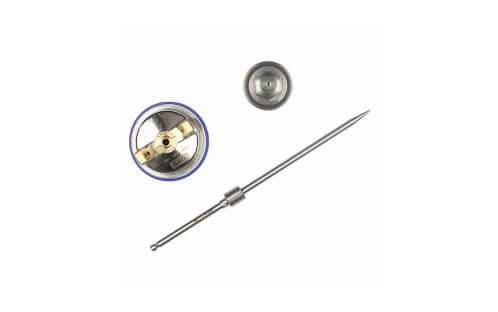
| Nozzle Selection for Finer Coating | Choose smaller orifice sizes and appropriate fan lengths, e.g., in the finer range 0.009" to 0.013" as a starting corridor for smaller material volumes |
| Nozzle Selection for Higher Throughput | For higher demand, use larger orifice sizes, e.g., 0.015" to 0.017" or higher – but only if pressure, viscosity, and coating goals require it |
| Fan Length | The table indicates fan lengths per nozzle; as a rule of thumb: shorter fans for narrow zones, longer fans for larger areas with appropriate gun positioning |
| Grounding | Ensure conductive integration via the mount or hoses; electrical resistance to ground should be below 10⁶ ohms |
Nozzle Selection: How to read the tables effectively
The manual shows standard and fine-finish nozzles with orifice, fan length, and water-based flow rate under defined reference conditions. In practice, these values are a good comparison framework, but not fixed production values.
- Small orifice sizes tend to provide less throughput and are often useful when finer layers or smaller components are required.
- Larger orifice sizes increase material throughput but also require clean process tuning to prevent runs, heavy centers, or unnecessary material application.
- The fan length affects surface coverage. Fans that are too large can create overspray and uneven edges on small parts.
- If too little material is applied at the maximum sensible pressure, the manual suggests that "more pressure" is not automatically the best solution – often the next nozzle size is the cleaner path.
Professional Workflow for Commissioning and Process Optimization
- Prepare the System: Mount the gun, set up fluid and air connections correctly, check grounding, and flush fluid paths with a suitable medium before first operation.
- Choose the Right Nozzle: Select orifice and fan length according to desired application volume, component geometry, and coating target.
- Set Fluid Pressure as a Guideline: Start with moderate pressure and do not go directly to the limit.
- Check Spray Pattern: Create a test pattern on a sample panel or original part and check for tails, heavy centers, multiple jets, or fluttering.
- Fine-tune Pressure: Increase only until a stable, clean pattern is achieved. Then evaluate layer thickness and wetting.
- Adjust Nozzle if Necessary: If throughput is insufficient, try a larger nozzle; if the application is too heavy, use a smaller nozzle or lower pressure.
- Secure Series Process: Document traverse, distance, viscosity, filter condition, and cleaning intervals to ensure the process remains reproducible.
Troubleshooting: 4 Typical Problems and Appropriate Measures
1. Spray pattern with top and bottom "tails"
- Increase fluid pressure step by step until atomization becomes clean.
- Check material viscosity and adjust if necessary.
- Question the nozzle size range; an orifice that is too large can degrade the pattern.
2. Fluttering or intermittent spray pattern
- Eliminate air entry in the material supply and check suction lines or connections.
- Clean partially clogged fluid paths or filters.
- Control material delivery for uniform pressure and stable supply.
3. Heavy center or excessive material application
- Check nozzle for wear and replace if necessary.
- Reduce fluid pressure or test a smaller nozzle.
- For very thin material, retune the entire process including viscosity and flow rate.
4. Gun does not close cleanly or drips
- Check needle and seat for contamination and clean thoroughly.
- Check for wear on needle, seat, or seals and replace worn parts.
- Control cylinder air relief, solenoid function, and permitted air pressure range.
Maintenance: These 5 points ensure process stability
- Flush fluid paths regularly with a suitable medium, especially before first operation and when changing products.
- Consistently check nozzle, needle, and seat for buildup, damage, and wear.
- Immediately inspect O-rings, packings, and sealing points on the gun and manifold at signs of leakage.
- Keep the filter condition in the material supply clean to avoid partial clogging and unstable spray patterns.
- Plan recurring service work with appropriate service kits instead of reacting only during unplanned system downtime.
FAQ for Binks AG-364
Which AG-364 variant is intended for circulating systems?
For applications with material circulation, the AG364-0000-T variant is intended. The S-version is the design without circulation.
Which pressures are relevant for the gun?
The decisive factors are the fluid pressure P1 and the cylinder air pressure P2. For P2, the manual states 4 to 10 bar; the maximum fluid inlet pressure is 275 bar. For process optimization, the fluid pressure should be started significantly below the limit as a guideline and then tuned step by step.
Does air influence the fan like in Airspray?
No, with the AG-364, the spray pattern is essentially influenced by fluid pressure and nozzle selection. The cylinder air is used for actuation, not for traditional air atomization.
Can the nozzle holder be aligned?
Yes. The nozzle holder can be indexed; according to the product page, alignment in 45-degree steps is possible, which facilitates adaptation to component geometries.
How do I recognize when the nozzle should be adjusted rather than the pressure?
If you have already reached a sensible pressure range but are still applying too little or too much material, nozzle size is usually the better lever. Pressure that is too high only compensates for an unsuitable nozzle in the short term and can increase mist, wear, or surface defects.
Check the AG-364 circulating version now
If you are looking for a compact automatic airless gun with a screw adapter and circulation for your system, you will find the matching product page here.
View AG-364Conclusion
The Binks AG-364 is a gun consistently designed for automatic airless processes. Those who view nozzle size, fan length, fluid pressure, viscosity, and maintenance status as a connected system will more quickly achieve a stable spray pattern, less cleaning effort, and reproducible coating results. For specific design, all values should be understood as practical guidelines and validated against the material and line.