WIWA FLEXIMIX 2 HERKULES GX
If you are coating large surfaces or thick layers and want to reliably process 2K materials, the FLEXIMIX 2 HERKULES GX electronic 2K series is designed exactly for these specifications: high area performance, high layer thicknesses, and the use of multiple guns or very long hose lines.

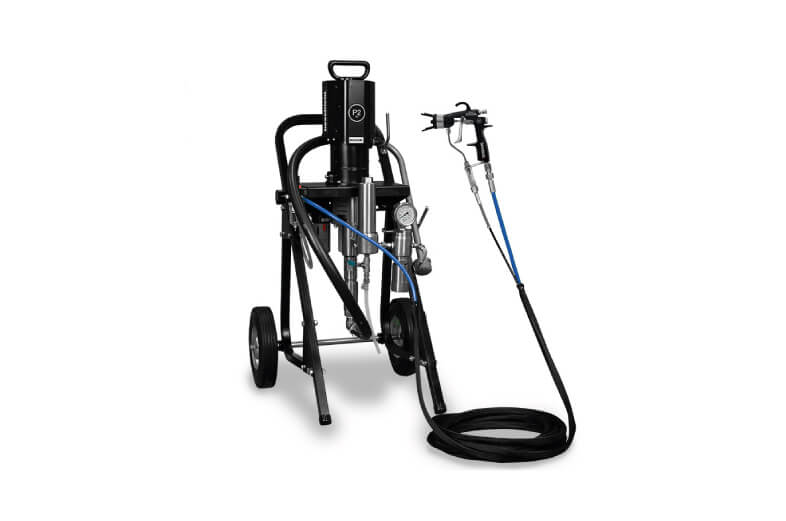
Product image (Example)
Product Overview: Variants, Applications, Advantages
The FLEXIMIX 2 family is designed as an electronic 2K series for maximum performance – especially where high material volumes, long hose packages, or multi-gun operation are required. Typical fields: large-scale or thick-film protective coatings (e.g., steel construction, marine, pipelines, plant engineering).
| Variant | Suitable For | Core Advantage (Practical) |
|---|---|---|
| FLEXIMIX 2 PHOENIX | 2K applications with a robust basic setup | Strong entry into the electronic 2K class |
| FLEXIMIX 2 PROFESSIONAL | When features/options are more in focus | More room for project-specific configuration |
| FLEXIMIX 2 HERKULES 270 | Large areas, thick layers, high performance | Volumetric mixing ratios 0.5:1 to 17:1 (Guide value per setup) |
| FLEXIMIX 2 HERKULES 333 GX | Same as 270 – with different pressure/performance characteristics depending on project/material | Multi-gun operation & very long hose lines possible (project-dependent) |
Note: The specific design depends on the material, viscosity, temperature control, hose length, guns/automation, and accessories – which is why configuration "on request" is practical.
Recommended Basic Settings (Guide Values)
The following starting values are deliberately formulated as guide values – the final adjustment is made via the material data sheet, desired wet/dry film thickness, nozzle/gun, temperature, and hose length.
- Mixing ratio: according to material specifications within the system spectrum (0.5:1 to 17:1 as a system guide value).
- Pressure/Ratio range: within the intended pressure ratios (270: 24:1–88:1; 333GX: 37:1–75:1 as guide values) tuned to the application.
- Operating pressure: increase step by step until atomization/spray pattern is correct – always below system limits (up to 450 bar as the upper limit of the series).
- Hose management: the longer the line, the more important pressure reserves and constant viscosity are (tempering/accessories project-dependent).
- Component control: define clear release/flushing sequences for additional components (up to 4 possible).
Important: If you run several guns in parallel or extremely long hoses, the design (nozzle, line, heating, material supply) is crucial – this is exactly what the configuration on request is intended for.
Pro Workflow: 6 Steps to a Stable 2K Application
- Project Check: Target layer thickness, area/output, material (2K chemistry), pot life, environment, approvals.
- Choose Design: 270 vs. 333GX (pressure ratio/performance window), number of guns, hose length, accessories (heaters, feed system, etc.).
- Parameterize Mixing Ratio: Set ratio according to data sheet (within 0.5:1–17:1) and define calibration/control routine.
- Gentle Start: Start low, check nozzle/spray pattern, then increase pressure in small steps – until clean atomization is achieved.
- Stabilize Process: Keep temperature/viscosity constant, plan for pressure losses with long lines, distribute operation symmetrically for multiple guns.
- Document & Reproduce: Note parameters (ratio, pressure, nozzle, temperature, hose, material batch) – this makes results repeatable.
Troubleshooting: 4 Common Problems (with Actions)
- Adjust pressure gradually (do not jump), check line/filter.
- Stabilize viscosity (observe material temperature and delivery path).
- Check parameterization/calibration (guide values are only a starting point – material spec is leading).
- Set start/stop sequences and flushing routines for long hose volumes.
- Match nozzle/gun to target output; consider pressure reserve.
- For multiple guns: Check distribution/line cross-sections (symmetry helps).
- Check pot life/temperature control; avoid breaks or define flushing/changeover.
- Standardize procedures (setup, spraying, stopping, flushing, downtime).
Maintenance: 5 Points That Really Count in Daily Life
- Daily: Visual inspection for leaks, hose condition, couplings, and filters.
- After Shift End: Defined flushing/cleaning routine (especially for reactive 2K materials).
- Weekly: Check wear parts on gun/nozzle, verify pressure stability.
- Monthly: Parameter audit (ratio/pressure/temperature) + documentation comparison for repeatable results.
- Project-related: Adapt configuration/accessories (heater, feed, automation) to actual conditions.
FAQ for FLEXIMIX 2 HERKULES GX (Practical)
Project Planned? We configure the right FLEXIMIX 2 HERKULES GX
To ensure that pressure ratios, mixing ratio, hose package, temperature control, and guns/automation really fit together, you receive a configuration from us on request – tailored to your material and target layer thickness.
Conclusion
The WIWA FLEXIMIX 2 HERKULES GX is a consistent 2K solution for demanding protective coatings: high area performance, high layer thicknesses, and the ability to run multiple guns or long hose lines – with mixing ratios in a wide spectrum and up to 4 controllable components. The key to a stable result lies in the project-specific design (material, hose, temperature, nozzle, process routine) – and this is exactly where a configuration on request provides the greatest practical benefit.