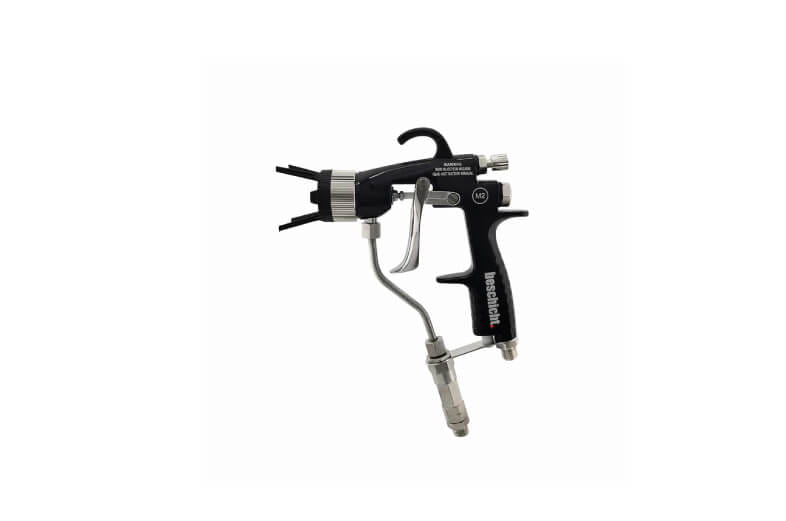
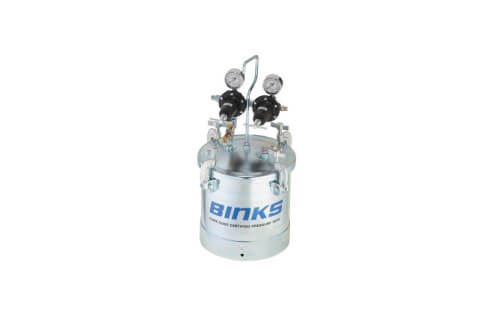
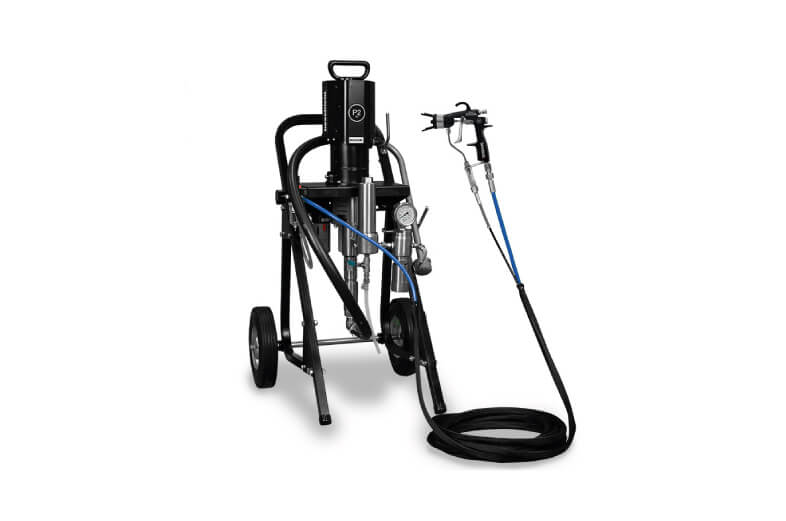
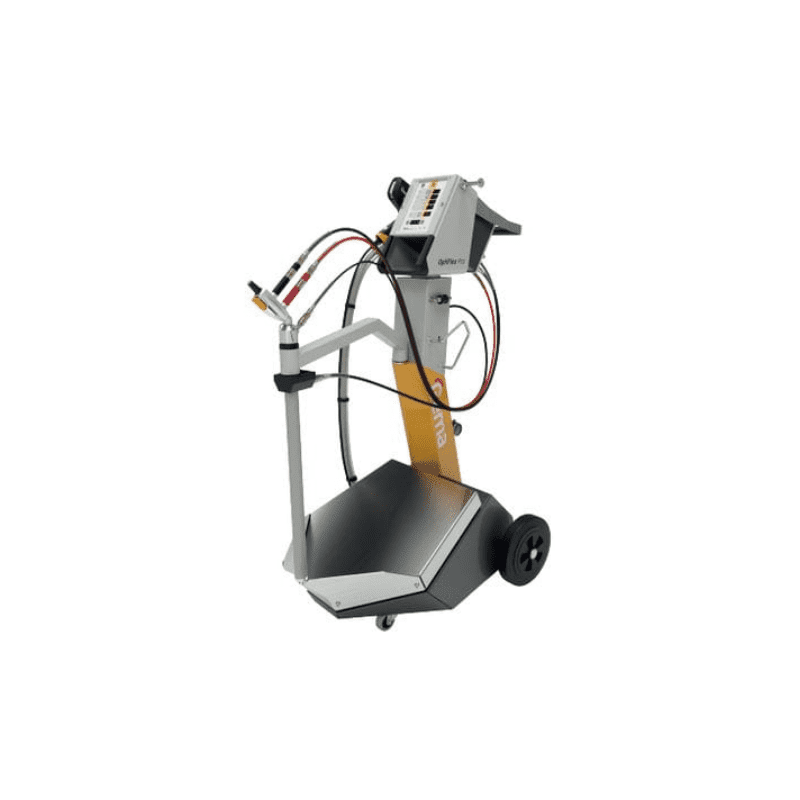
WIWA FLEXIMIX 2 Professional GX
When large surfaces, thick coating layers, and changing requirements come together, process reliability is key: correct mixing ratio, stable delivery, clean flushing, and traceable parameters. The FLEXIMIX 2 series is designed for exactly that – including use with multiple guns or long hose packages.

Note: Illustration may show options/accessories (project-dependent configuration).
Product Overview: Variants, Applications, Advantages
The FLEXIMIX 2 series is designed as an electronic 2K solution for high performance – ideal for large surfaces, thick coating layers, and operation with multiple guns or very long hose lines.
| Variant | Typical Uses | Guide Values (from data) | Practical Advantage |
|---|---|---|---|
| FLEXIMIX 2 Phoenix | Large surfaces & thick layers, 2K materials from low to high viscosity |
Mixing ratio 0.5:1–17:1 Pressure ratio 10:1–52:1 Max. 416 bar Up to 4 components |
Solid entry into the FLEXIMIX 2 performance class |
| FLEXIMIX 2 Professional GX | Larger projects with changing requirements, even with short pot lives |
Mixing ratio 0.5:1–17:1 Pressure ratio 32:1–71:1 Max. 460 bar Up to 4 components |
High process reserve + accessory/heating options for very viscous materials |
| FLEXIMIX 2 Herkules GX | Maximum performance for very high demands / large delivery volumes |
Mixing ratio 0.5:1–17:1 Pressure ratio depending on version up to 88:1 Max. up to ~497 bar Up to 4 components |
Maximum power option within the series |
Recommended Basic Settings (Guide Values)
These starting values are derived from the available system data. For the final parameterization, the material data sheet (viscosity/temperature/pot life) and your specific configuration apply.
- Mixing Ratio: Set according to material specification (system range: 0.5:1 to 17:1).
- Pressure Ratio (Drive/Delivery Reserve): Professional GX operates in the range 32:1 to 71:1 (helpful for viscous media and long lines).
- Working Pressure: Select within material approval; system is designed for up to 460 bar (not to be understood as standard operating mode).
- Component Management: Up to 4 components controllable – use this for defined recipes and reproducible processes.
- Accessories/Temperature Control: For very high viscosity, plan material heating/heating accessories to reduce pressure demand and pulsation.
Pro Workflow: In 6 Steps to a Stable 2K Process
- Material Check: Check A/B (and any other components) for temperature, homogeneity, and processing window.
- Set Recipe/Ratio: Parameterize the mixing ratio in the system according to material specifications (within 0.5:1–17:1).
- Build up Delivery: Bleed lines, stabilize pressure; with long hose packages, ramp up slowly.
- Optional Temperature Control: For highly viscous media, activate heaters/heating accessories to improve flow behavior.
- Stabilize Process: Run a test spray pattern, fine-tune nozzle/filter/material temperature until edges, wetting, and spray pattern are correct.
- Document & Finish Cleanly: Record parameters, end process, start flushing routine (flushing path as short as possible).
Troubleshooting: 4 Typical Problems (Incl. Actions)
- Check material temperature/viscosity, use temperature control if necessary (less pressure loss).
- Check filter/nozzle for partial blockage; increase pressure only step-by-step.
- For long lines: Optimize hose routing, cross-section, and transitions (reduce pressure losses).
- Check recipe/mixing ratio (setpoint vs. material specification), then perform a test spray.
- Stabilize material supply A/B (fill level, feed, minimize air/moisture influences).
- Strictly adhere to flushing and start sequences so that no partial mixture remains in the process.
- Select nozzle suitable for viscosity, fine-tune spray pressure within approval.
- Check temperature/heating (too cold = poor atomization, too warm = risk of runs).
- Standardize spray distance/overlap (constant, reproducible).
- Minimize flushing path: only flush the necessary section (mixer → gun).
- Select flushing agent/procedure compatible with the material; do not "push" the pot life.
- Avoid downtime in the process: better to stop in an orderly fashion, flush, and restart.
Maintenance: 5 Points That Really Help
- Regularly clean filters, nozzles, and mixing/flushing components and check for wear.
- Check hoses/connections for leaks, kinks, and pressure resistance (especially with long lines).
- Replace seals/wear parts preventively if pressure build-up or process stability decreases.
- Check temperature control/heating accessories (if used) for target temperature, sensors, and even heat distribution.
- Document parameters/recipes (for repeat orders) and evaluate deviations early.
Ready for Your Project? (Configuration instead of Compromise)
The FLEXIMIX 2 Professional GX is typically designed on a project-specific basis (material, pot life, hose lengths, number of guns, heating/accessories). Let us record your requirements cleanly – then you will receive a suitable configuration.
Note: Buttons lead to the product/inquiry page. There you can initiate the design (e.g., heating, flushing system, guns, hose package).
FAQ (Practical)
When you run large projects with changing requirements and want to reliably dose 2K materials from low to high viscosity – even with short pot lives and optional temperature control.
The system range is 0.5:1 to 17:1 (volumetric). The specific ratio must always come from the material data sheet.
The FLEXIMIX 2 series is explicitly designed for high surface performance, thick layers, and parallel work with multiple guns or long hose lines.
Up to 460 bar maximum operating pressure (configuration dependent). Use this as a reserve – operation occurs within material approval and process windows.
In practice, material heaters or heating accessories help to lower viscosity, reduce pressure requirements, and make the spray pattern more stable.
Conclusion
The WIWA FLEXIMIX 2 Professional GX is a strong choice if you want to run 2K coatings on large surfaces reproducibly and efficiently: wide mixing ratio, high pressure reserve, and expansion options (e.g., heating/accessories) for viscous materials – plus clear process guidance for changeovers, flushing, and documentation. If you tell us your material, pot life, hose lengths, and desired performance, we will design the right configuration for you.