
Setting up the Sagola 4600 correctly: Nozzle, Pressure & Workflow for a Professional Finish
Do you want fast coverage, clean metallic orientation, and less overspray? In this guide, you will get field-tested reference values (pressure, distance, fan) and a clear decision-making aid for the right nozzle – including workflow, troubleshooting, and maintenance.
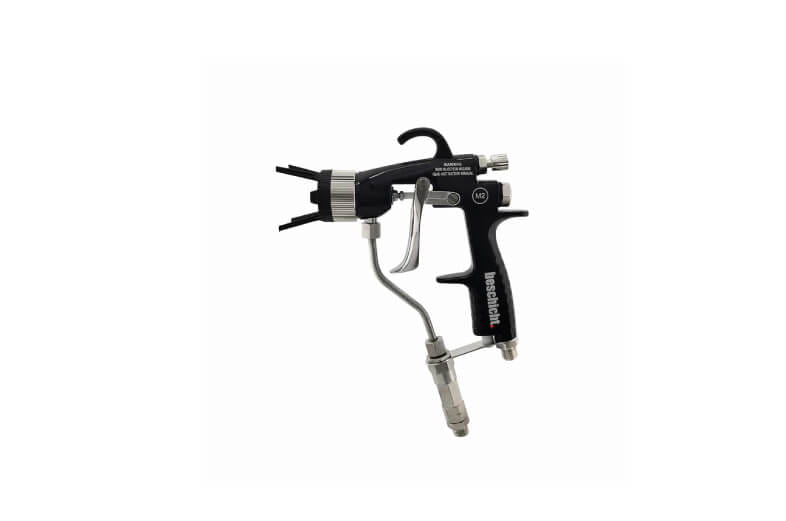
Product Image (Blog Asset)

Note: Values & setups in this article are intended as reference values (material, climate, viscosity, and technique vary).
Why the Sagola 4600 "just works" so often
- Uniform spray pattern from top to bottom – especially helpful for metallics, silvers & pearlescents.
- Fine atomization at lower working pressures (DFT™).
- Fewer wear/sealing parts in the fluid area (M2M™) – faster cleaning & lower follow-up costs.
Quick Decision: Which Sagola 4600 version fits which application?
| Version | Typical Application | Pressure (Ref. Value) | Air Consumption (Ref. Value) | Strengths |
|---|---|---|---|---|
| DVR BASE | Basecoat (Waterborne & Solvent), difficult colors | approx. 1.8–2.0 bar | approx. 280 L/min | Stable fan pattern, clean metallic orientation |
| DVR HVLP | HVLP applications, reduce overspray | approx. 2.0 bar | approx. 450 L/min | Very fast in HVLP, maximum overspray reduction |
| DVR CLEAR | Clearcoat / Solid Color / OEM quality | approx. 2.2 bar | approx. 295 L/min | Very fine atomization, low overspray |
| DVR CLEAR PRO | High-Gloss / “Mirror Finish”, Express Clears & Solids | approx. 2.2 bar | approx. 315 L/min | Max. control + wide fan width |
Reference values from manufacturer specifications – fine-tune depending on paint (viscosity), temperature, dilution, and technique.
KPI Boxes: What you noticeably improve with the correct setup
Recommended Basic Settings (Ref. Values from Datasheet)
| Parameter | DVR BASE (Basecoat) | DVR CLEAR / CLEAR PRO (Clearcoat) |
|---|---|---|
| Working Pressure (Air Inlet) | approx. 1.8–2.0 bar | approx. 2.2 bar |
| Spray Distance | approx. 18–20 cm | approx. 18–20 cm |
| Fan Width | approx. 290–315 mm* | approx. 275–310 mm* |
| Air Consumption | approx. 280 L/min | approx. 295–315 L/min |
*Manufacturer fan width specifications vary by source/format – interpret as a practical guideline and finalize on a test panel.
Nozzle Selection: 1.20, 1.20XL, 1.30, 1.30XL or 1.40?
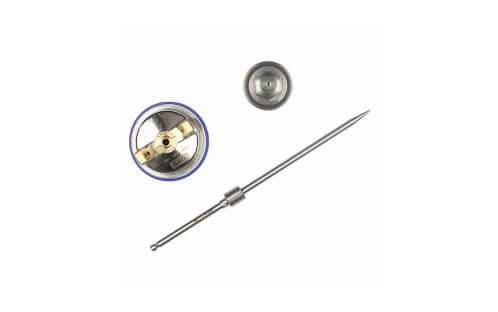
The Sagola 4600 is offered with nozzle sets (needle/nozzle) in 1.20 / 1.20XL / 1.30 / 1.30XL / 1.40. In practice: smaller = finer & more controlled, larger = more material throughput & speed.
| Nozzle | Typical Use | If you see this... | Then better... |
|---|---|---|---|
| 1.20 | Fine application, high control | Too dry application / thin material film | Slightly more material or 1.20XL/1.30 |
| 1.20XL | Slightly more throughput, stays controlled | You need speed but want to stay "safe" | 1.20XL as all-round upgrade |
| 1.30 | All-round (very popular), good throughput | Inconsistent coverage at fast pace | 1.30 or 1.30XL (for high speed) |
| 1.30XL | More material, faster build-up | You want to stand "wet" faster | Maintain more control over speed/distance |
| 1.40 | Max. throughput (e.g. Solid/HS), work swiftly | Runs too easily / too much material per pass | Switch to 1.30/1.30XL or reduce material |
Professional Workflow (5–7 Steps) for Basecoat with Clean Orientation
- Set pressure as reference (Base: approx. 1.8–2.0 bar at air inlet) and check on a test panel.
- Open fan fully, then 1–2 clicks back until the edge remains clean (no "fraying").
- Start material flow with moderate opening: better 2 clean, even passes than "too wet" on the first pass.
- Maintain distance (Ref. value: approx. 18–20 cm) and constant speed for even metallic distribution.
- Overlap consistently (evenly, without "stop-and-go"). This avoids clouds/striping.
- Control pass: if necessary, a light "orientation" pass (minimally less material) to lay metallic down smoothly.
- Intermediate check under good light (e.g. LED) – before building up further.
Troubleshooting (4 typical problems + measures)
- Reduce material slightly and overlap more evenly.
- Increase distance minimally (within reference range) instead of greatly increasing pressure.
- If you are "too dry": use 1.20XL/1.30 instead of excessive pressure.
- Decrease distance slightly and adjust speed.
- Open material flow slightly (instead of "even more air").
- Check if air supply/compressor provides enough volume (note L/min).
- For CLEAR/CLEAR PRO, maintain reference pressure (approx. 2.2 bar) and work "wet" but controlled.
- Increase material slightly if necessary and reduce speed.
- Choose suitable nozzle: a nozzle that is too small can create insufficient material film.
- Reduce material flow or switch to a smaller nozzle (e.g. from 1.40 to 1.30/1.30XL).
- Maintain distance (not too close) and follow through with a steady hand movement.
- Work in two controlled passes instead of one "too wet" pass.
Maintenance: 5 points to secure your finish & lifespan
- Clean immediately after use: Aircap, nozzle, needle – do not let paint residue dry.
- Check fluid filter (80-mesh) – often the fastest "fix" for an unstable spray pattern.
- Keep Aircap clean: uniform holes = uniform fan.
- Assemble carefully: seat the nozzle set correctly, do not cross-thread.
- Replace wear parts specifically: M2M™ reduces gasket/seal issues in the fluid area, but check mechanical parts regularly.
Video (Practical Impression)
If embedding in your Shopware editor is restricted, alternatively use the link: https://www.youtube.com/watch?v=6kZMhj3RIXE
FAQ (short & practical)
1) Which pressure is a good starting point?
For basecoat (DVR BASE), the manufacturer's reference is approx. 1.8–2.0 bar at the air inlet; for CLEAR/CLEAR PRO approx. 2.2 bar. Then fine-tune on a test panel.
2) Why does metallic sometimes look streaky?
Often it is a combination of too much material, unstable speed, or inconsistent overlap. First stabilize material/technique – only then adjust pressure.
3) What does “XL” bring for 1.20/1.30?
In practice, XL variants often stand for slightly more material throughput with similar control – ideal if you want to work faster without going "large" (1.40) immediately.
4) Is my compressor enough?
Check the reference air consumption of the chosen variant (e.g., DVR BASE approx. 280 L/min; HVLP significantly higher). Undersupply often manifests as an unstable spray pattern or "dry" application.
5) Which nozzle is the safest all-round choice?
Many professionals choose 1.30 (or 1.30XL if more throughput is desired) for a universal mix of control & speed. Paint/setup remains decisive.
Conclusion
The Sagola 4600 shows its strength when you bring nozzle, pressure, distance, and overlap together cleanly: stable fan, finer atomization, and less rework. Use the reference values as a starting point – and choose the nozzle consistently based on desired material throughput and control.
Order the matching Sagola 4600 variant now
Choose the right needle/nozzle combination directly for your setup: