
DeVilbiss Advance HD: Complete Guide to Cleaning, Maintenance and Repair
A high-quality spray gun like the DeVilbiss Advance HD is a precision tool. Regular and proper maintenance is the key to consistent performance, long service life and perfect spray results. In this detailed guide, we show you how to professionally clean your Advance HD, replace typical wear parts and troubleshoot common problems yourself.

Why systematic maintenance is so important
Neglected maintenance not only leads to poor results, but can also result in costly repairs or premature replacement of the entire spray gun. Thanks to its modular design and high-quality materials (stainless steel, hardened aluminum), the Advance HD is very maintenance-friendly. These three pillars are essential:
1 Cleaning
Prevents material from drying inside fine channels and seals – the most common cause of malfunctions.
2 Inspection
Regular inspection of seals, needles and nozzle sets detects wear early before failures occur.
3 Replacement
Wear parts such as the PTFE needle packing are designed as consumables. Replacing them in time keeps the gun performing like new.
Always work with appropriate protective equipment (gloves, goggles) and in well-ventilated areas. Before any disassembly, make sure the compressed air line is depressurized and the material container is removed. Use only cleaning agents recommended by the paint or solvent manufacturer.
Matching spare parts & tools for your Advance HD
Secure original DeVilbiss wear parts such as nozzle sets, needle packings and seal kits now. This ensures you are perfectly equipped for every maintenance task.
Go to spare parts & accessoriesStep 1: Daily basic cleaning (after every use)
- Empty & release pressure: Remove the material container. Pull the trigger to release residual pressure from the air line.
- Flush the material path: Fill a suitable cup (e.g. GFC-501) with the recommended cleaning agent. Spray until only clean solvent exits.
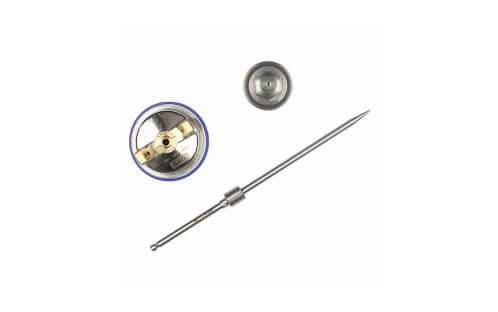
- Clean air cap & nozzle set: Loosen the air cap (counterclockwise). Carefully remove the needle. Clean the air cap, nozzle and needle tip with a soft brush in a solvent bath. Never scrape with metal pins or knives!
- Dry & reassemble: Thoroughly dry all parts (compressed air drying is ideal). Lightly oil the needle (see Step 3), reassemble all parts correctly and tighten (hand-tight only, do not overtighten with tools).
Step 2: Replacing the needle packing (PTFE) – how to do it
The self-adjusting PTFE needle packing is a wear part. If material leaks from the handle behind the needle, replacement is required.
| Step | Procedure | Note |
|---|---|---|
| A. Disassembly | Fully remove the needle. Use a suitable wrench to loosen and unscrew the packing housing (behind the fluid adjustment). | Often hand-tight; use tools gently if necessary. |
| B. Replacement | Remove the old PTFE packing. Insert the new packing cleanly and without twisting into the housing. | Do not grease or oil the packing. |
| C. Assembly | Screw the housing back in (hand-tight). Insert the needle and operate it several times to seat the packing. | After installation, perform a leak test with air (without material). |
Step 3: Lubrication of moving parts
Proper lubrication reduces friction, makes the trigger smoother and protects against corrosion. Less is more!
- Needle: Apply a minimal drop of light machine oil (e.g. spindle oil) to the rear end of the needle (not the tip!) and operate several times after installation.
- Trigger mechanism: Lightly oil the trigger pivot point in the handle area.
- Important exception: NEVER oil or grease the PTFE needle packing, seals or the material path!
Troubleshooting: What you can check and fix yourself
| Problem / Symptom | Possible cause | Corrective action |
|---|---|---|
| Gun does not spray / sprays very little material | Clogged nozzle or needle tip. Material pressure too low (pressure pot). Closed material adjustment. | Clean nozzle set (see above). Check pressure pot. Open material adjustment. |
| Material drips from the nozzle at rest | Worn needle tip or nozzle seat. Contamination between needle and seat. Loose needle packing. | Inspect/clean needle tip and nozzle seat. Retighten or replace needle packing. |
| Uneven, speckled spray pattern | Damaged or dirty air cap (horn holes). Air pressure too low. | Thoroughly clean air cap. Check for cracks/damage. Set air pressure according to specification. |
| Air leaks from handle or controls | Defective O-rings/seals in the air valve or controls. | Identify defective seals and replace with original spare parts. Use a seal kit. |
Maintenance schedule & checklist
Use this simple checklist to keep track of the most important maintenance intervals.
| Task | after every use | weekly / 40h | annually / if problems occur |
|---|---|---|---|
| Basic cleaning (nozzle, air cap, needle) | ✅ | – | – |
| Oil needle | ✅ | – | – |
| Check needle packing (for leaks) | – | ✅ | – |
| Inspect all seals & O-rings | – | – | ✅ |
| Complete disassembly & deep cleaning | – | – | ✅ |
When to consult a professional? Limits of self-repair
The Advance HD is designed for user maintenance. However, in the following cases you should contact an authorized DeVilbiss service center:
- Damaged housing: Cracks or severe deformation of the cast aluminum body.
- Defective air valve: The separate “balanced air valve” cannot be cleaned or no longer functions correctly (e.g. remains open).
- Severely worn nozzle set: If spray quality remains poor despite cleaning and a new nozzle set does not help, the internal nozzle carrier may be damaged.
- Complex leaks: If air or material continues to escape from an unclear location even after replacing all accessible seals.
Conclusion
With the DeVilbiss Advance HD, you are investing in a durable and maintenance-friendly industrial tool. Systematic care according to this guide – from daily cleaning and timely replacement of the PTFE packing to regular inspection – is the best guarantee of years of reliable performance and perfect spray results. Remember: cleanliness in spray guns is not just a matter of appearance, but of functionality. Keep a stock of the most important wear parts on hand so you are well prepared for all routine maintenance tasks.