
Setting up Sagola 4600 HEX correctly: Reference values, Workflow & Buying Guide
If you want to work cleanly, evenly, and material-efficiently with basecoat or clearcoat, the gun setting determines the result. In this guide, you will get field-tested reference values (pressure, distance, air cap), a 7-step professional workflow, typical fault patterns including fixes – and matching shop links for the 4600 DFT variants.

Why HEX (and why settings matter so much)
HEX technology is designed for particularly controlled pre-atomization: the goal is a calm, flat spray pattern and uniform droplet distribution – especially when you have to work with higher material flow or want to lay "critical" metallic tones cleanly. Still, the decisive factor remains: pressure, air cap, viscosity, and distance must match, otherwise mottling, dry application, or unnecessary overspray will occur.
Product Overview: Variants, Applications, Advantages (Table)
| Variant / Air Cap | Typical Application | Recommended Nozzle Sizes | Key Advantage |
|---|---|---|---|
| DVR BASE | Water- & solvent-based basecoats | 1.20 / 1.20 XL / 1.30 | Uniform metallic orientation, controlled application |
| DVR HVLP | Basecoats + special coatings (HVLP setup) | 1.20 / 1.20 XL / 1.30 | Reduced overspray, high air volume approach |
| DVR CLEAR | HS/UHS Clearcoats + single-stage paints | 1.20 / 1.20 XL / 1.30 | Fine atomization for gloss & flow |
| DVR CLEAR PRO | Express-drying clearcoats (High Gloss) | 1.20 / 1.20 XL / 1.30 | Fast & high gloss – when timing counts |
Note: Nozzle sizes & air caps depend on the material and the desired flow rate. Use these specifications as a guide and always check with the paint manufacturer.
Recommended Basic Settings (derived from manual – reference values)
| Parameter | Reference / Starting Point | Why it's important |
|---|---|---|
| Recommended Working Pressure | 1.4–2.2 bar (starting range) | Too high = more mist, less efficiency; too low = coarse/"grainy". |
| HVLP Working Pressure (Inlet) | 1.8 bar (HVLP reference) | HVLP should not be "overdriven" – otherwise overspray increases and transfer decreases. |
| Factory Setting / Performance Start | 2.0 bar inlet pressure | Good reference point for most applications – then adjust to the material. |
| Spray Distance (EPA) | 15–20 cm | Stable fan, good efficiency with controlled mist. |
| Spray Distance (HVLP) | 12–15 cm | HVLP works closer to the object to improve transfer. |
| Max. Inlet Pressure (Safety) | 4 bar (do not exceed) | Protects people, material, and result – more pressure doesn't make it "better". |
Pro Workflow (7 Steps)
- Ensure Clean Compressed Air: Filter out oil/silicone/aerosols and solid particles – clean air is the basis for constant atomization.
- Prepare Material: Mix according to the paint data sheet, filter it, and adjust viscosity accordingly (base/clear depending on system).
- Open Main Regulators: Fully open the fan control and product regulator (without removing them), then "dial down" cleanly from there.
- Set Pressure as Reference: Start in the range of 1.4–2.2 bar (HVLP: 1.8 bar) and check with a spray test.
- Adjust Fan: Align air cap openings, set fan width via the fan control (wide for surfaces, rounder for edges/spot).
- Fine-tune Material Volume: Slowly open the product regulator until the desired amount is reached; for narrow areas, "dose" via the trigger.
- Keep Distance & Speed Stable: EPA typ. 15–20 cm, HVLP 12–15 cm. Too slow = too thick; too fast = too dry/thin.
Troubleshooting (4 typical problems + quick actions)
- Check the nozzle/seat and tighten it.
- Clean the seat on the nozzle body; replace if damaged.
- Material present? Air pressure present and sufficient?
- Material too thick: thin it; open/adjust product regulator.
- Lines/nozzle: clean them.
- Refill material; always filter (avoid impurities).
- Tighten the nozzle; replace in case of cracks or a defective needle seal.
- Clean the air cap; harmonize air pressure/volume/viscosity.
- Readjust the fan opening; check product for foreign bodies and filter.
Maintenance: 5 points to keep the gun "like new"
- Clean after every job: Clean the gun and cup with a suitable solvent; no hard/metallic objects on precision holes.
- Check product filter: Clean or replace the filter depending on contamination – clogged filters cause poor application.
- Treat air cap gently: Deformations at the air outlet worsen atomization – soak, blow out, and clean carefully if necessary.
- Don't forget lubrication: Lightly grease threads/friction zones after cleaning (use silicone-free lubricants).
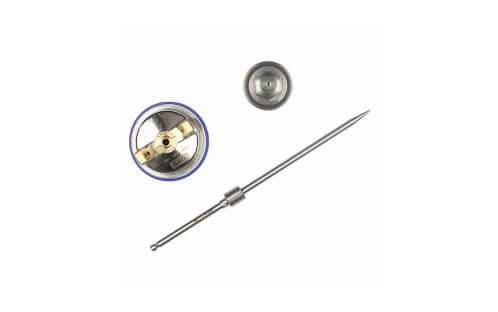
- Use original parts: Interchangeability and function remain stable; replace seals/needle/nozzle in good time if leaks occur.
Video (Practical Insight)
If you prefer to see the 4600 in action "live", watch the video:
▶️ Watch on YouTube: Sagola 4600 in useFAQ (practice-relevant)
CTA: Buy matching Sagola 4600 DFT/HEX variants directly
Choose the variant suitable for your application (Base/Clear/Express-Clear/HVLP) or complete your nozzle set for reproducible results.
Conclusion
The Sagola 4600 HEX plays to its strengths when you view it as a system: clean air, filtered material, matching air cap, stable distance – and pressure only as high as necessary. Start with the reference values, optimize via spray test, and consistently follow cleaning + lubrication – then you will reproducibly get a calm spray pattern, clean metallic orientation, and clear brilliance with clearcoat.