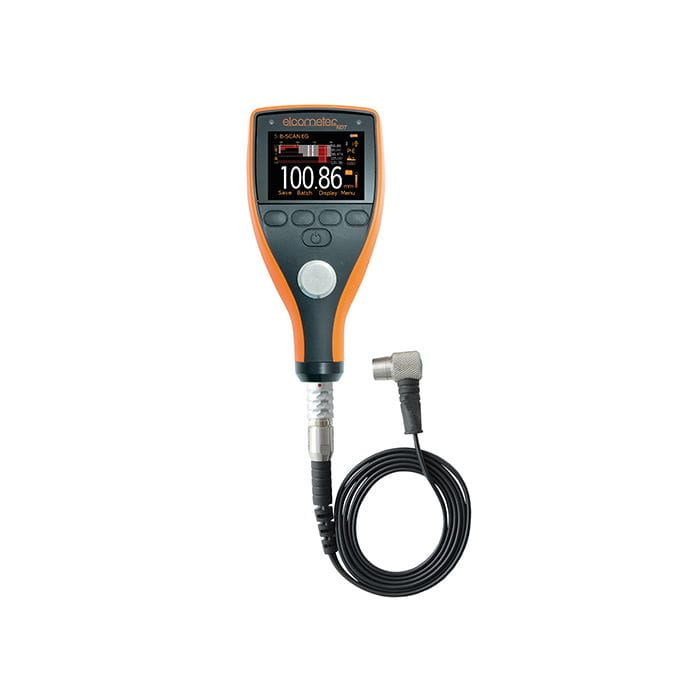

Standard-Compliant Coating Thickness Testing – Using the Elcometer 456 Safely for ISO, SSPC & NAVSEA
Public tenders, industrial projects, and quality audits require standard-compliant coating thickness measurements. This practical guide shows you how to correctly set up the Elcometer 456 for ISO, SSPC, and NAVSEA requirements – including measurement strategy, limit values, and typical sources of error.

- Deviations from standards often lead to rework or acceptance delays
- Incorrect averaging falsifies test results
- The Elcometer 456 offers standard presets – but they are often used incorrectly
Standards Overview: Which measurement method and when?
| Standard | Typical Application | Measurement Logic |
|---|---|---|
| ISO 19840 | Industry, Steel Construction, Corrosion Protection | Multiple measurements, defined averages |
| SSPC PA2 | International, Offshore, Oil & Gas | 3 measurements per spot, average |
| NAVSEA | Military / Marine | Special display & limit logic around 254 µm |
Recommended Device Settings (Guidelines)
| Parameter | Recommendation |
|---|---|
| Measurement Mode | Standard or Standard Preset (ISO / SSPC) |
| Calibration | Rough / 2-point for blasted surfaces |
| Statistics | Enable Counted Average |
| Limit Values | Lower & upper limits according to specification |
All values are guidelines and depend on project specifications and standard versions.
Always activate Batch Mode for standard-relevant measurements. Individual measurements without a batch structure are often considered non-compliant in audits.
Typical Standard Errors & How to Avoid Them
- ❌ Using individual values instead of standard-compliant averages
- ❌ Smooth calibration on blasted steel
- ❌ Failing to document limit values
- ❌ Not exporting measurement data in an audit-proof manner
CTA: Measure with Standard Compliance using the right Probe
For standard-compliant measurements on rough substrates, the right probe is crucial.
View Armored Elcometer 456 ProbeConclusion
The Elcometer 456 is ideal for standard-compliant coating thickness testing – if the measurement mode, calibration, and evaluation are selected correctly. Properly implementing ISO, SSPC, or NAVSEA requirements significantly reduces discussions, rework, and acceptance delays.