Elcometer Qualicoat Powder Coating Inspection Kit: How to Test Safely, Quickly & According to Standards
If you want to secure powder coatings on aluminum components according to Qualicoat logic, you need reproducible tests – from appearance & gloss to coating thickness, adhesion, deformation, and oven temperature profiles. This kit is designed exactly for that. The measurement/test fields include appearance, coating thickness, impact/deformation, adhesion, and oven temperature.
Note: Product/set specifications may change – information in the article serves as practical orientation.

What is Qualicoat – and why this kit?
Qualicoat defines minimum requirements for equipment, materials, test equipment, and end products for powder-coated aluminum architectural applications. The inspection kit bundles the typical testing devices into one package – for stable QA routines in incoming goods, the production line, and final inspection.
Product Overview: Variants, Use & Advantages
| Variant | Who is it for? | Typical Advantages |
|---|---|---|
| Basic (YKITQUALICOAT-1B) | QA start, internal testing, focus on DFT measurement on smooth surfaces + standard mechanics/adhesion. | Includes an integrated FNF coating thickness gauge for smooth surfaces (Model 415) as well as the core testing equipment for deformation/impact/adhesion. |
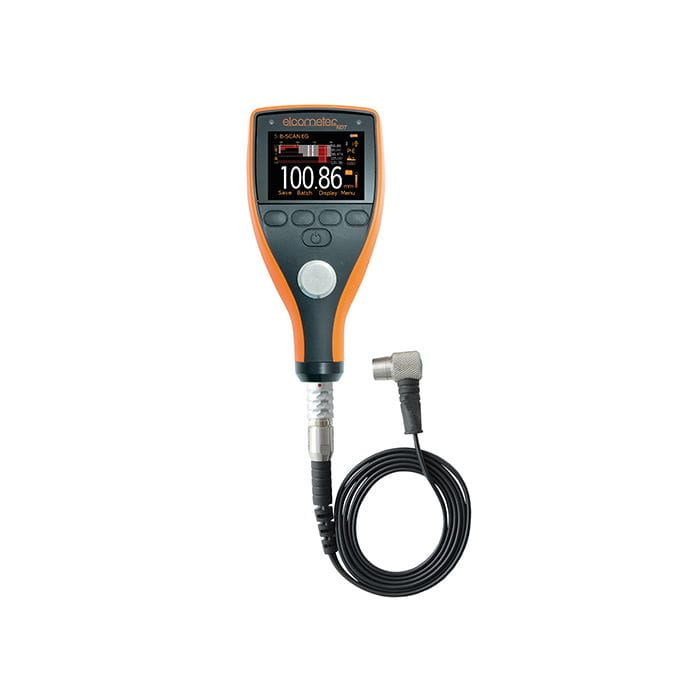
| Top (YKITQUALICOAT-1T) | Regular audits, high comparability, advanced DFT measurement with separate probe + advanced gloss measurement. | Includes a separate FNF coating thickness gauge (Elcometer 456, Model T) including standard FNF probe (0–1500 µm) and glossmeter (Elcometer 480, 60°). |
What's in the Kit? (Short List)
| Device / Test Equipment | Purpose? | Basic | Top |
|---|---|---|---|
| Elcometer 480 Glossmeter 60° | Gloss/Appearance (60° measurement) | Model B | Model T |
| Elcometer 1506 Mandrel Bend (5 / 8 mm) | Bending/Deformation Test | ■ | ■ |
| Elcometer 1615 Base Unit + Tube & Kit B | Impact/Deformation according to ISO 6272/2 & BS 6496 | ■ | ■ |
| Elcometer 1620 Manual Cupping (Digital) | Cupping/Formability Test | ■ | ■ |
| Elcometer 215 Oven Temperature Profiling System | Oven Temperature Profile (Barrier included); K-Type probes optional | ■ | ■ |
| Elcometer 415 FNF Integral (smooth surfaces) | Coating thickness on smooth substrates | ■ | – |
| Elcometer 456 FNF Separate (Model T) + Probe | Coating thickness (separate probe); Probe: 0–1500 µm (guideline) | – | ■ |
| Elcometer 1542 Cross Cut Set (1/2/3 mm) + Tape | Adhesion Test (Cross-hatch) | ■ | ■ |
CTA: Secure Your Suitable Set Directly
Would you like to start directly with Qualicoat-compliant tests or professionalize your audit setup? Then choose the set that fits your line reality.
Recommended Default Settings (Guidelines)
The exact target values depend on the powder coating, specification, and component. As a guideline start for clean, comparable measurements, the following has proven effective:
- Glossmeter: Consistently use 60° measurement for comparability (same measuring field, same cleaning routine).
- Coating Thickness: Measurement with FNF devices; for the Top set, plan for a probe with a measuring range up to 0–1500 µm as an orientation value.
- Oven Profiling: Temperature profile with appropriate barrier/logger configuration; K-Type probes are optional and must be ordered separately if required.
All values/scopes as guidelines – manufacturer-side changes/set configurations possible.
Professional Workflow (5–7 Steps)
- Define Test Plan: Which tests per batch/lot (Appearance/Gloss, DFT, Adhesion, Deformation, Oven Profile).
- Define Reference: Reference plate + boundary sample (OK/NOK) for fast release decisions.
- Check Appearance/Gloss: Visual inspection + 60° gloss measurement at fixed points.
- Measure Coating Thickness: FNF measurement at several points; mark outliers and start root cause analysis.
- Mechanical Tests: Mandrel Bend / Cupping / Impact depending on specification – document results.
- Adhesion: Cross-hatch with appropriate blade geometry (1/2/3 mm) + tape routine.
- Verify Oven Profile: Logger run for setup changes/load changes; document trends.
Troubleshooting (4 Typical Problems)
- Standardize measuring points (number/position) and clean the surface before measuring.
- Check if the substrate/geometry matches the measurement method (smooth vs. complex).
- Check tape routine & cut pattern (uniform cuts, suitable 1/2/3 mm geometry).
- Process check: Cross-check pretreatment/degreasing and curing window via oven profiling.
- Check component temperature/oven profile (under/over-curing can affect mechanical properties).
- Document powder batch/material changes and run comparison samples.
- Clean glossmeter window & reference surface; strictly maintain measurement angle (60°).
- Record line parameters (powder application, grounding, load) as a trend and correct deviations early.
Maintenance & Best Practice (5 Points)
- Regularly clean measuring surfaces/equipment windows (Appearance/Gloss & DFT benefit immediately).
- Store testing devices in a shock-free manner and consistently use the transport case.
- Check cross-hatch blades for wear and replace if cuts are unclean.
- Temperature Profiling: Allow barrier/logger to cool down after use and perform a visual inspection.
- Standardize documentation (checklist + photo of the test surface) for audit security.
FAQ (Practical)
Typically, it covers appearance, coating thickness, impact/deformation, adhesion, and oven temperature profiling – exactly the fields frequently required in Qualicoat-compliant QA.
In practice, it is primarily the coating thickness setup: Basic relies on the integrated measuring device (415) for smooth surfaces, while Top uses the separate system (456 Model T) including a probe. Additionally, the 60° gloss measurement in the Top set is designated as "Model T".
The profiling system is part of the kit; a wide range of K-Type probes is available as an option and is purchased separately according to requirements.
For reliable decisions, multiple measurement points are useful (edge/center, critical geometries). Define a fixed measurement scheme so that trends are truly meaningful.
Yes – the instruments can also be used for other testing tasks; the kit is a bundled setup for recurring QA routines.
Conclusion
With the Elcometer Qualicoat Powder Coating Inspection Kit, you build an audit-proof, practical QA routine: appearance/gloss, coating thickness, adhesion, deformation/impact tests, and oven profiling in one system. Choose Basic for a fast, solid entry – or Top if you prefer maximum comparability and the separate DFT setup.