OptiSelect GM03: Choosing Electrodes & Nozzles Correctly – for Stable Charging and a Clean Spray Pattern
If the spray pattern appears "unsteady," powder builds up on the electrode/deflector plate, or the coating thickness fluctuates, the cause is very often not the powder itself – but rather the combination of nozzle, electrode (or electrode holder), and the correct electrode rinsing air. In this guide, you will find a clear selection aid, guide values, and a quick professional workflow for the OptiSelect GM03.
Quick Explanation: What Happens at the Electrode & Nozzle?
- Flat jet nozzle (ventilated) with rinsed central electrode: Powder is charged via the central electrode; rinsing air prevents sintering/buildup during spraying.
- Round jet nozzle with deflector plate + rinsed central electrode: The deflector shapes the powder stream into a "cloud"; here too, rinsing air reduces deposits on the deflector and electrode.
- Important: Rinsing air is not an "extra," but part of the nozzle function – incorrect values can visibly worsen the spray pattern.

Nozzle Overview: Which Nozzle for Which Application?
| Nozzle Type | Typical Application | Strengths | Practical Tip |
|---|---|---|---|
| Flat Jet Nozzle (e.g., NF20/NF27) | Profiles / Flat parts, "standard" coating | Controlled, oval spray pattern; good for reproducible paths | If the oval "frays" or becomes irregular, wear or incorrect rinsing air is often the cause |
| Flat Jet Nozzle for Complex Profiles (e.g., NF21/NF22) | Complex profiles, recesses, targeted spraying | Better "pull-in" into contours (depending on geometry) | Perfect in combination with clean, short distances & moderate powder rate |
| Round Jet Nozzle (e.g., NS04) + Deflector Plate | Large surfaces, "cloud-like" application | Very uniform cloud; deflectors available in several diameters | If deposits occur on the deflector plate: check rinsing air / cleaning / fit |
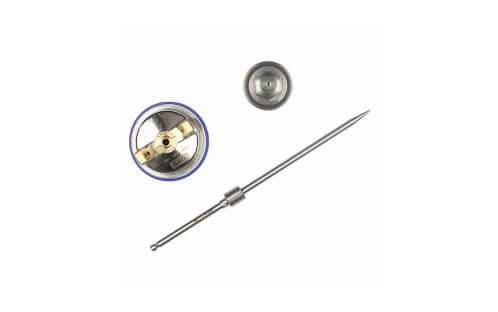
Note: In the spare parts overview, flat-jet and round-jet nozzles are listed as wear parts (including deflector plate options).
Recommended Basic Settings (Guide Values)
These values are guide values (depending on powder, geometry, and grounding). They help you reach a stable range quickly.
| Parameter | Guide Value | Benefit |
|---|---|---|
| Powder Rate (factory recommended) | 60% | Stable starting point for many applications – then optimize for coating thickness. |
| Total Air (factory recommended) | 4 Nm³/h | Defines the "cloud"; too little air → cloud too dense/unsteady. |
| Initial Operation Powder Output | 50% | Good start because the control unit automatically keeps the total air constant. |
| Electrode Rinsing Air (nozzle dependent) | ≈ 0.1 to ≈ 0.5 Nm³/h | Reduces deposits; "too much" rinsing air can negatively affect the spray pattern. |
Requirement: Compressed air must be oil- and water-free – especially when cleaning/blowing out.
Professional Workflow: Select Nozzle, Mount, Stable Setting (6 Steps)
- Define Part & Goal: Large surface → Round jet/deflector; Profiles/Flat parts → Flat jet; Deep contours → targeted Flat-Jet variants.
- Clean Nozzle Dry: Blow out inside/outside with compressed air (no solvent baths), check fit.
- Check Mechanics: Tighten threaded sleeve/cap firmly – loose mounting increases risk of discharges and worsens stability.
- Set Guide Values: Start with 60% powder rate & 4 Nm³/h total air (or initial 50% powder output), then fine-tune.
- Rinsing Air to match Nozzle: Set electrode rinsing air according to nozzle design (guide value ≈0.1 to ≈0.5 Nm³/h).
- Test Spray Pattern: Spray into the booth, visually check cloud/profile and only optimize in small steps (do not compensate with "Max-Powder").
Troubleshooting: 4 Typical Nozzle/Electrode Problems
- Rinsing air too low or incorrect for the nozzle → Set guide value range and fine-tune.
- Nozzle dirty inside → blow out dry, remove any sintered deposits if necessary.
- Too much rinsing air → can worsen spray pattern; return to stable range.
- Nozzle worn (grooves/slot/wall thickness) → replace nozzle.
- Loose fit → tighten threaded sleeve/cap properly.
- Air values unsuitable → adjust total air/powder rate in small steps.
- HV/Current deactivated → check HV setting.
- Workpiece not grounded → check/improve grounding (very common cause).
- Error message/Hardware defect possible → use troubleshooting/service.
- Compressed air missing → check supply.
- Clog in nozzle/hose/gun → clean; then use PowerClean/Rinse mode if available.
Maintenance (5 Points, Quick to Implement)
- Daily: Blow off the outside of the gun and clean dry.
- Nozzle Daily/Per Shift: Clean inside/outside with compressed air – never immerse in solvent.
- Weekly: Remove powder hose, remove and clean nozzle, blow out gun in flow direction; clean hose separately and reassemble.
- Monthly: Check nozzle for wear and replace if necessary (spray pattern/slot/electrode holder wedge).
- Important: Certain solvents are explicitly not permitted – use only suitable cleaners and preferably dry compressed air.
CTA: Frequently ordered for stable delivery & quick changes
Especially during nozzle changes/service, it is worth looking at the wear parts in the connection area – so that delivery and fit remain stable after the modification: